
Study at Concordia University
An English-speaking university at the heart of Montreal

The University of Concordia comprises 4 principal faculties (Arts and Science, Engineering and IT, Fine Arts and the John Molton School of Business) and numerous schools, centers and research institutes.
The university offers more than 300 undergraduate programs and 100 programs at Master’s level.

The University of Concordia
The John Molson school of Business at the University is among the best management schools in Canada and benefits from a good international reputation.
Concordia also boasts more than 200,000 graduates around the world.
Studying at Concordia constitutes an interesting alternative to >McGill University for students who wish to study in Quebec in English and in which the average sits around 11 to 14/20.
How do I apply?
The selection process at the University of Concordia is divided into multiple steps that we will describe below:

How can I submit my application to Concordia?
You must submit your application on the Concordia website which must comprise the following elements:
- Your score in an English test (IELTS, TOEFL)
- Your official school report from 11th and 12th grade.
- Your predicted results from the Bac.

When do you have to start preparing for the University of Concordia?
The deadline for applying to Concordia is fixed at January 15th of your final year.
All the documents must be sent to the University of Concordia before March 15th.
What is the profile of the students at the University of Concordia?
Concordia is a selective university. The admission decision is based on your 3 class reports of your penultimate year and your first report of your final year, your predicted results and your final Bac results (in the case that you already have them).
The minimum requirement to be admitted to Concordia is, according to the programs, between 11 and 15/20 on the French Bac (see this website for equivalent in your country).
In all cases, the most selective programs require at least a ‘Bien’ grade at the Baccalaureate.
Moreover, you must also demonstrate a very good command of the English language (a minimum of 7 in the IELTS or 90 in the TOEFL).

Are you ready to study at Concordia?
We’re here to help you.


How can we support you in your application?
Study at Columbia University
A prestigious Ivy League school in the heart of New York
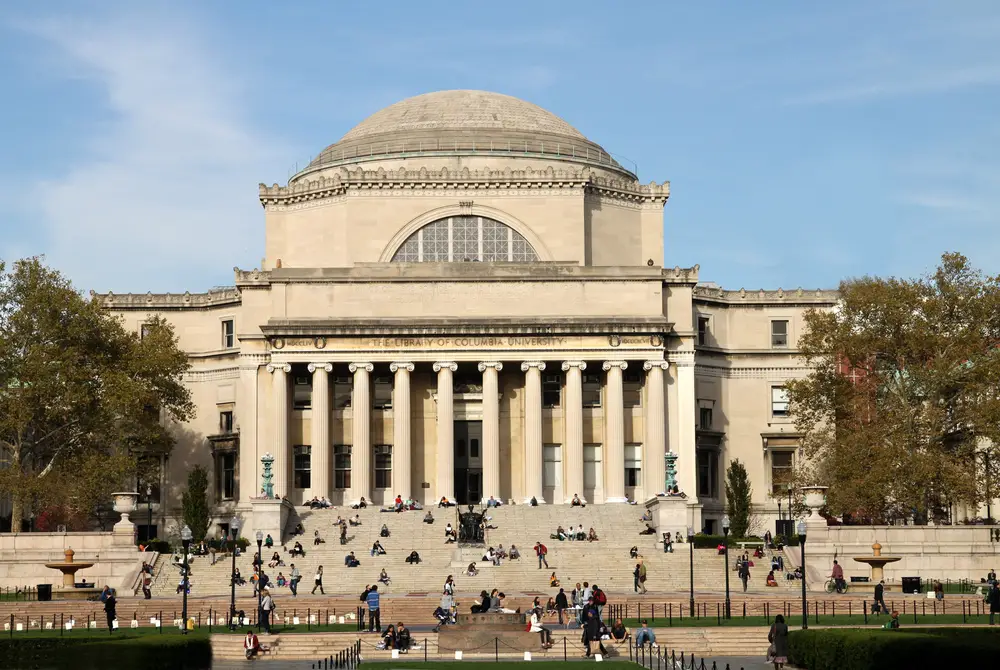
In 1754, an institution of higher learning was chartered by royal decree in the colonial city of New York. It would become Columbia University in the City of New York, one of the top universities in the United States and indeed in the world. In 2017 Columbia’s undergraduate acceptance rate was 5.5%, which made it the third most selective college in the United States and the second most selective in the Ivy League. It is currently ranked 16th by QS World University Ranking 2018, 2nd among U.S. colleges and 2nd among Ivy League schools for 2017 by Wall Street Journal and Times Higher Education.
Columbia University in a few words
In 2017, its student population was 32,429 (8,868 students in undergraduate programs and 23,561 in postgraduate programs), with 42% of the student population identifying themselves as a minority and 28% born outside of the United States.
Since its creation, Columbia University has educated American and world leaders, beginning with Alexander Hamilton – class of 1777-, later to become the primary economic advisor to George Washington, the first American President. The University is well-acquainted with success as just this year, In addition, Professor Joachim Frank shared the Nobel Prize in chemistry. The University itself awards the famed Pulitzer Prize each year in twenty-one categories for excellence in newspaper journalism, literary achievements and musical composition. This year, the University also graduated a diverse group of 16,000 students from more than 100 different countries.
Campus
Despite its location in busy Manhattan, the 32 acre (13 hectare) campus of Columbia University is gated, and therefore provides the best of both worlds within the Morningside Heights neighborhood on the border of Upper West Side and Harlem.
Among the most-loved places to spend time on campus, the “Low Steps”, the nickname for the staircase leading up to Low Memorial Library, probably take the prize. The building is also one of many buildings National Historic Landmark sites at Columbia. Built in 1895 by then University President Seth Low as Columbia’s central library, it would later be replaced by the Butler Library, the university’s largest single library with over 2 million volumes. Philosophy Hall also bears the historical honor as the site of the invention of FM radio with WKCR, the radio station run by Columbia students.
Almost two dozen undergraduate dormitories (purpose-built or converted) are located on campus or in Morningside Heights. As a consequence, undergraduate students are guaranteed on-campus housing during their studies.
Academic matters
There is a long-standing tradition of newspaper publication and media broadcasting at Columbia. Of note, the Columbia Daily Spectator is America’s second-oldest newspaper written entirely by students, and The Columbia Review has the honor of being the nation’s oldest college literary magazine. Its Columbia Television (CTV) is also the second-oldest student television station in the nation.
Columbia University is an inclusive community with 42% self-identifying as a minority. Additionally, the Columbia Queer Alliance is the oldest gay student organization in the world, founded as the Student Homophile League in 1967. As proof of their political engagement, Columbia’s students participated in the student protests of 1968 over two issues related to perceived racial aggression (the building of a gym in neighboring Harlem) and the university’s membership in a weapons research think-tank controlled by the Pentagon. The students protests were successful on both counts.
Academics
Research has an important place at Columbia and the University prides itself in the fact that even undergraduate students participate in this endeavor. Indeed, the University can claim major accomplishments in many areas including biological and biomedical sciences. The school was site where the uranium atom was split, and where the laser was invented. Columbia was also the first American university to confer MD degrees for medical studies beginning in 1767. Engineering is yet another area in which Columbia shines. The university is a top supplier of young engineering entrepreneurs for New York City, and over the past 20 years, graduates of Columbia established over 100 technology companies.
In addition computer and information sciences and support services, visual and performing arts and social sciences are all popular academic programs. In social sciences, the School of International and Public Affairs has drawn upon the resources of the faculties of political science, economics, and history since its inception 1946. Today its most notable academic is the internationally celebrated expert University Professor Joseph Stiglitz, winner of the Nobel Prize in Economics in 2001 and named by the magazine Time as one of the 100 most influential people in the world in 2011.
The university is organized into twenty schools, including undergraduate as well as graduate schools and Barnard College, an all-female institution. Graduates of Barnard are issued diplomas authorized by both Columbia University and Barnard College. The university also has several affiliates outside of the US, called Columbia Global Centers in Beijing, Amman, Paris, Mumbai, Istanbul, Nairobi, Rio de Janeiro and Santiago de Chile. Each is intended “to promote and facilitate international collaborations, new research projects, academic programming and study abroad, enhancing Columbia’s historical commitment to global scholarship” (https://globalcenters.columbia.edu).
How do I apply?
According to Columbia, about 10% of the Class of 2017 were educated abroad, representing over 30 countries. As the University says, “We also value the fact that international applicants, regardless of citizenship, have much to offer from their backgrounds and experiences as global citizens” (https://barnard.edu/admissions/internationalstudents). In addition to the requirements listed below for Columbia University, applicants may also chose to participate in an optional interview with an alumnus/a of the University.
To apply to Columbia, you will need to use the Common Application, a centralized platform through which you can apply to most American colleges and universities. You will need to fill in information about your family – including the occupation of your parents -, provide your transcript or high school grades, submit 2 teacher recommendation letters, submit one “school report”, draft a résumé or CV, send official test scores (SAT, SAT Subject Test scores, ACT and English language test scores – note that the essay portion of the ACT/SAT is not required), declare a major or intended area of study, describe your extracurricular activities and as with most highly selective colleges complete the essay questions on the Common App as well as answer additional essay questions specific to Columbia.
You must submit all your materials before the appropriate deadline. If you are sure that Columbia is your first choice, then you may want to apply for Early Decision, which may increase your chances for admission. Early Decision materials must be submitted by November 1st. The University stipulates that you must complete ACT/SAT/an English language test by November. Materials for Regular Decision must be submitted by January 1st. In this case, students may opt to take the ACT/SAT/an English language test (TOEFL, IELTS, DET) as late at February. SAT subject tests are not required by Columbia, however it is probably a good idea to take the tests that correspond to your interests and strengths. Finally, the University will accept your highest scores from each section of the ACT/SAT separately. This is known as “superscoring”.

The Application
Your application for a Bachelor’s at Columbia University must comprise the following elements :
- The”Coalition Application” or “Common Application”, which is composed of questions specific to Columbia :
- Lists and descriptions of all activities and accomplishments of the student (“achievements, activities, employment and summer activities”),
- “Personal essay”
- “Columbia-specific questions”
- Your school grades
- Official transcript of your school report card.
- Recommendation from a school counselor and school profile (“school profile”)
- A completed “Mid-Year Report”
- Standardized tests
- Score from SAT or ACT
- Score from a standardiZED English exam (IELTS, TOEFL, DET)
- 2 letters of recommendation from teachers
- these recommendations must come from teachers of academic subjects
- For candidates applying to engineering one of these recommendations must be from a teacher of mathematics or science
- Complementary documents for the application :
- Supplementary materials
- Optional interview with an alumnus/a

When do you have to start preparing for Columbia University
Taking into account the numerous specific requirements for American universities like taking exams; consistently participating in extra-curricular activities including clubs, music, sports, and side projects; and the numerous essays to write, we recommend that students begin start to think about their path to Stanford as soon as they begin high school. The application itself is typically completed during the fall semester of students’ last year in high school.
What is the profile of students at Columbia University
“The admissions process at Columbia is a “holistic” one, taking many factors into careful consideration. Columbia does not rely on standardized testing and grades alone and instead looks at all parts of every application to help inform its judgment. Admissions reads personal statements to try to understand each candidate and what motivates him or her. Admissions reads teacher recommendations carefully to understand a candidate’s contributions in the classroom and what that candidate might offer his or her Columbia classmates.”
It is worth noting that applying to Barnard College, is also open to female students. Out of 7,716 applicants, 15% – 603 students – were admitted to the class of 2011. That’s 10% more than at Columbia University overall.

Are you ready to study at Columbia?
We’re here to help you.
How can we support you in your application?
Study at the University of Cambridge
Academic excellence and tradition in the world’s 4th oldest university

The University of Cambridge is one of the most prestigious UK universities and is located in the charming town of Cambridge in England.
Second in the ranking of best universities in the world in 2018 (THE’s World University Ranking 2018), Cambridge has thousands of illustrious graduates. Cambridge alumni notably includes: Charles Dickens, Isaac Newton, Emma Thompson, Arianna Huffington, Alan Turing and Stephen Hawking. Moreover, 96 of their former students and professors have received the Nobel prize and 10 have received the Fields Medal.
Today, the University of Cambridge is home to more than 21 000 students who are part of 31 colleges and one hundred academic departments.
The University of Cambridge
The University of Cambridge shares numerous traditions with the University of Oxford, which explains why they are often grouped together with the term ‘Oxbridge’.
The University of Cambridge is home to more than 21 000 students who are part of 31 colleges and one hundred academic departments.
Second in the ranking of best universities in the world in 2018 (THE’s World University Ranking 2018), Cambridge has thousands of illustrious graduates. Cambridge alumni notably includes Charles Dickens, Isaac Newton, Emma Thompson, Arianna Huffington, Alan Turing and Stephen Hawking. Moreover, 96 of their former students and professors have received the Nobel prize and 10 have received the Fields Medal.
Alongside the University of Oxford, Cambridge is one of the most selective universities in England, even the world, with only 1 candidate in 5 admitted.
Academic matters
At the undergraduate level, 30 courses are on offer, from which students should pick just one. Some courses cover multiple subject areas, for instance:
- Natural Sciences allows students to choose modules in hard sciences, from Biology, Physics and Chemistry to Earth Sciences and Mathematics
- Human, Social and Political Sciences students can choose modules such as Politics and International Relations, Anthropology and Sociology
Most degrees on offer at Bachelor’s level are typically 3 or 4 years long. Each year at Cambridge is made up of three terms. Cambridge terms, like those at Oxford, are quite unique amongst UK universities, since each term is only 8 weeks long.
These intense study periods are packed full of activity, and allow a deep focus on academic matters through lectures, supervisions*, and private study. Science students typically have lab-sessions at least once a week, and students of essay subjects will normally have 1-2 essays to work on during each week of term.
*What are supervisions?
Oxford and Cambridge are unique amongst UK universities in offering regular one-to-one or small-group discussions with expert academics. These give students a chance to go deeper into the subject by asking questions, reflecting on topic content, and receiving extra reading recommendations personalised to your particular interests in the subject, or what you are hoping to explore further.
At Cambridge, you could find yourself in lectures or supervisions with the same academic that has professionally published a book or journal article on the topic you are studying!
Term-time is also the perfect time to interact with other students in between study sessions and through student societies. Read on for more about student life at Cambridge!
Living and studying in Cambridge
Cambridge students are housed within one of the 31 colleges, each with their own personality. For a good overview of the Cambridge colleges, their location in the city and student life there, see the university prospectus.
The Cambridge colleges are spread around Cambridge, a city with a bustling centre and plenty of green spaces, museums, and a stunning mixture of architecture. The colleges in themselves are havens for students in the city, offering a space to live, share meals with fellow students, relax, and of course study.
Study spaces are numerous, and include: departmental buildings and libraries, the University library, smaller College libraries, and other spaces such as shared or private study rooms, College JCRs (Junior Common Rooms), which also double as a place to socialise with other students of the College.
While Cambridge students work hard, they also like to ‘play hard’, and there are plenty of opportunities to make the most of the student experience at Cambridge. From traditional formal halls and May Balls, to the 959 (!) student societies on offer. Societies are a chance to get involved in something new, pursue an existing hobby.
Around Cambridge, you could also shake off your essay stress at a student bar, watch a show at the ADC theatre (whose stage once saw the likes of ex-students Rachel Weisz, Ian McKellen and Hugh Laurie) or see talks by big-name speakers at the cambridge union.
In terms of getting around the city, many people get around Cambridge (to lectures, for instance) on foot or by bike, although the city is also well served by buses. Travelling outside of Cambridge is also convenient: taking a train from Cambridge’s train station will allow you to get to London in under an hour, whether for a day-trip or for a weekend.
How do I apply?
Note: If you decide to apply to Cambridge for Undergraduate level in order to obtain a Bachelor of Arts (BA), you will not be able to apply to Oxford as well. You will therefore have to choose between either applying to Oxford or to Cambridge.
What are the different stages of the application?
There are several steps:
- Application
- Test
- Interview
- Conditional offer
- Acceptance
The details of these steps are covered below.
Beginning your application
Once you have decided on your ideal course of study, you will have to begin filling in the candidate file on the UCAS platform, which allows you to apply to up to 5 different courses/universities in the UK.
The UCAS application consists of a written Personal statement (of up to 4,000 characters) as well as a letter of recommendation from one of your teachers. After submitting your UCAS application, you will also be invited to fill out a Cambridge-specific Supplementary Application Questionnaire (SAQ), in which you will confirm certain details from your academic transcript.
You will also be asked to choose one of Cambridge’s colleges in your application, specifying choosing the one you wish to apply to. It is also possible to make an ‘open application’ (in which you do not indicate one college in particular, but will be assigned one automatically).
Interview and admissions tests
If your application is successful in the first stage (following submission of the UCAS application and Personal Statement), you will then be invited to an interview at the start of December in Cambridge. In this interview, the objective is to test your academic capacities and your motivation for your subject in front of a few members (‘fellows’) of the College you applied to. Given that Cambridge is highly selective, these interviews are very demanding and require a large amount of preparation.
If your application is successful in the first stage (following submission of the UCAS application and Personal Statement), you will then be invited to an interview at the start of December in Cambridge. In this interview, the objective is to test your academic capacities and your motivation for your subject in front of a few members (‘fellows’) of the College you applied to. Given that Cambridge is highly selective, these interviews are very demanding and require a large amount of preparation.
The conditional offer of admission
Finally, if you succeed in the interview stage, you will then receive a ‘conditional offer’ of admission. Offers should be received by 15th January.
Our Oxbridge Admissions Pack can help you through the entire Cambridge or Oxford admissions process.

When do you have to start preparing for the University of Cambridge?
The deadline for applying to the University of Cambridge is fixed at October 15th of your final year.
In all cases, take into account the huge scale of preparation required for admission to Cambridge, it is strongly recommended to start preparing yourself from the start of your penultimate year in order to maximize your chances of success.
A good way to prepare for studying in Cambridge is to have a good look at the information for your course so as to know what to expect. Once you are confident in your choice of subject and your determination to study at Cambridge, you should begin researching your course further by reading around your subject.
It would also be a good idea to go to an open day. Open days run throughout the year, but most occur in the months leading up to October. For specific dates, you should look out for subject-specific open days, college-specific open days, and university-wide open days.
In 2019, Cambridge will be holding uni-wide open days on 7 & 8 July 2022. For these open days, booking is necessary: Sign up to the Student Newsletter to be notified when bookings open and for other opportunities, advice and resources.
What is the profile of the students at the University of Cambridge ?
Admission to the University of Cambridge is reserved for the best students and requires both excellent school results and lots of rigorous preparation.
Given the extreme selectivity, we recommend that you only apply to this University if you can show excellent academic results and can be sure of obtaining the highest grades in your final year of pre-university studies (i.e. a ‘Très Bien’ grade in the French Bac). The University of Cambridge is also particularly reputed for their science programs and expectation will be even higher for these.
Moreover, given the selection process contains interviews, you must also master the English language.
If you are confident that you fit the profile of a Cambridge student, the next step is to reflect on whether the workload and supervision system is right for you.
Finally, you should do all that you can to start preparing for studies at Cambridge, in order to create a stand-out application and so that you can adapt well to new the living and studying conditions on arrival.

Financing your studies
Fees:
Following UK Government’s amendment of the regulations relating to fee status due to Brexit, EU, EEA and Swiss students will now be classified as international/overseas students.
Tuition fees for international students vary depending on the course studied. Most international students also have to pay College fees in addition to tuition fees. See this page for details.
Are you ready to study at Cambridge?
We’re here to help you.

Study at UCB (University of California, Berkeley)
The best public university in the United States

Located 10 miles (about 16 km) across the bay from San Francisco in the Bay Area of Northern California, The University of California, also known as Berkeley or Cal, is America’s #1 public university (U.S. News & World Report) and #27 in the world overall (QS World University Rankings). The sprawling, 500 hectare (1200 acre) campus of Berkeley is home to over 30,500 undergraduate and more than 11,300 graduate students.
The history of UC Berkeley dates back to 1868 when it became the first of what would be a network of 10 University of California universities. Led by its first president Henry Durant, a minister who had initially come to California with his wife to open a school, the University quickly found itself the lucky recipient of benefactors such as American feminist, philanthropist, and suffragist, Phoebe Hearst.
Perhaps a relationship can be established between the tone that was set by Berkeley’s first president, the values of its early benefactor and the University’s continued social engagement and political activism. Indeed, students and faculty of UC Berkeley were particularly noted for the Free Speech Movement as well as the Anti-Vietnam War Movement both led by its students in the 1960s. And their engagement goes well beyond the borders of the United States. The University also holds the honor of being the #1 All-time producer of Peace Corps volunteers.
Berkeley University in a few words
In recent years, students have continued to find new ways to engage with the community. Since 2003, the Haas School of Business has recruited and trained students from all majors to work on pro-bono consulting engagements with real-life nonprofit clients. Indeed Berkeley has significant entrepreneurial tradition. Among its alumni are founders and co-founders of such global companies as Apple, Coursera, Gap Inc., Intel, Mozilla, Myspace, Rotten Tomatoes, SanDisk and Tesla.
Berkeley has a remarkable track record of scientific discoveries and inventions including the development of the flu vaccine by chemist Wendell M. Stanley in the 1940s, the creation of the atomic bomb by physicist J.R. Oppenheimer in 1943, the polio virus in 1954, the launch of an affordable treatment for malaria in 2006 and improvement on this treatment in 2013, and many more (https://www.berkeley.edu/about/history-discoveries). As a public research university, Berkeley depends on money from the State of California. However, private donors have made significant contributions to the important research efforts performed on campus. This includes the 2016 donation by Mark Zuckerberg and Priscilla Chan for 0 million to establish the BioHub, which in its own words is “committed to solving the world’s biggest problems – together.” (https://www.czbiohub.org/)
The campus
Campus life
Although extremely vast, the “central campus” of Berkeley covers 72 hectares (178 acres). The beautiful buildings on campus reflect the French influence of their original design by Emile Bénard although the construction of Beaux-Arts Classical style campus was ultimately overseen and modified by the American John Galen Howard. One of Howard’s works the Sather Tower, also known as The Campanile, stands boldly in the the middle of campus. Its chimes can be heard for miles around. It has the particularity of resembling a similar clock tower in Venice and for being the 3rd highest in the world.
A major competitor in Division I sports among American universities, Berkeley students proudly support their teams with help from Oskie the Bear, their well known mascot, who wears the team logo “Cal”. Students have the option of living in one of 12 residence halls including the International House built with funds provided by John D. Rockefeller, Jr, the only son of the famous American philanthropist.
Further away from the center of campus, forests, streams and wildlife abound, including two branches of Strawberry Creek and Founder’s Rock, which connect this campus with the history of the California frontier.
Academics
At Berkeley students can pursue one of 106 Bachelor’s degrees, 88 Master’s degrees, 97 research-focused doctoral programs and 31 professionally focused graduate degrees. Moreover, with greater than 130 departments and programs are divided into 14 colleges and schools including the Haas Business School, the College of Chemistry, the College of Engineering and Berkeley School of Information where students study computer science among other subjects.
According to the QS World University Rankings by subject, Berkeley deserves a spot in the top 10 in every area included in the ranking: Environmental Sciences (1); Chemistry (2); Civil & Structural Engineering (2); Sociology (2); Material Sciences (3); Electronic & Electrical Engineering (3) and the list goes on!
The following phD programs are also top ranked: Agricultural and Resource Economics, Astrophysics, Chemistry, Civil and Environmental Engineering, Computer Science, English, Epidemiology, Geography, German, Mathematics, Mechanical Engineering, Biochemistry and Molecular Biology, Genetics, Genomics, and Development, Physics, Plant Biology, and Political Science.
1525 full time faculty teach at Berkeley including 7 Nobel Prize winners, 4 Pulitzer Prize winners and 137 members of the National Academy of Sciences. The University also boasts an impressive system of 32 libraries on campus for a total of 11 million volumes. The Bancroft Library, one of the largest special collections libraries in the United States, stands nobly in the center of campus.
How do I apply?
To apply to Berkeley, you will first need to use UC Application portal. Once you have filled in some preliminary information, you will be able to log into the My Application Portion (MAP@Berkeley), a system unique to the University of California system, to complete your application.
Berkeley does not require you to submit letters of recommendation, but you may do so if you believe will have a positive effect on your application. One letter should be from a teacher. You must complete all tests: ACT/SAT/SAT Subject tests, on or before the December test date. Subject tests are not required for most areas but can be beneficial to your application. Subject tests are recommended for “the College of Engineering and College of Chemistry, including Math Level 2 and a science test (Biology E/M, Chemistry, or Physics) closely related to the your intended major. Include the scores in your application. UC uses the highest scores from a single test administration”. (https://admissions.berkeley.edu/freshmen-requirements)
The University requires you to answer 4 out of a list of 8 “Personal Insight Questions” (350 words each). See http://admission.universityofcalifornia.edu/how-to-apply/personal-questions/freshman/index.html for more information. You must submit all your materials between November 1st-30th.

When do you have to start preparing for Berkeley University ?
Taking into account the numerous specific requirements for American universities like taking exams; consistently participating in extra-curricular activities including clubs, music, sports, and side projects; and the numerous essays to write, we recommend that students begin start to think about their path to Stanford as soon as they begin high school. The application itself is typically completed during the fall semester of students’ last year in high school
What is the profile of the students at Berkeley University ?
“Since Berkeley is a competitive campus, satisfying the minimum requirements is often not enough to be competitive for selection… We review students using a Holistic Review process. This means that we not only look at academic factors, but also non-academic factors. Using a broad concept of merit, readers employ the following criteria which carry no pre-assigned weights”. (https://admissions.berkeley.edu/freshmen-requirements)
Out of 1,362 International applicants for 2017-218, 15,448 were accepted for an admit rate of 8.8% (*The overall rate of admission for Berkeley is 18%.). In 2018, that rate dropped to 8.7%. As may be evident, the profile of international students is slightly more competitive in terms of GPA as well as ACT and SAT scores. (https://admissions.berkeley.edu/student-profile)
Are you ready to study at Berkeley?
We’re here to help you.
Study at the University of Bath
A university with a global outlook in an exceptional setting

The University of Bath is nestled in the region of Somerset, England, one hour by train from London on a hilltop overlooking the town of Bath.
Bath is one of the top universities in England and in 2018 it took the 6th spot in national rankings in The Guardian and the 160th place in the QS World University Ranking.
In 2014, it also achieved the title of ‘Best Campus University in England’ in the Times, a list that it continues to appear on. So what makes this place so special?
The city of Bath
With around 90,000 year-round residents, Bath just may be the most charming city in England. The Telegraph agrees saying that the city, which is a World Heritage Site, “pretty much ticks all the boxes”.
Tourists come from far away to visit the famed Roman Baths as well as more modern spas – the city’s full name is Bath Spa after all. The Bath Abbey and the Royal Crescent and Circus – both beautiful Georgian architectural feats inspired by the city’s Roman heritage – the Jane Austen Centre, beautiful green parks… these are just a few of the most popular landmarks!
Students will find that the city, located a short bus ride down the hill from the University of Bath’s campus, also offers plenty of eateries, bars, nature activities, cultural events and stunning scenery.
The campus
The main campus of the university, reminiscent of many American college campuses, is situated in the periphery of Bath, and was constructed in 1964 in the modernist style of the era. The University’s proximity to such a charming city and its academic excellence make it a great alternative to London’s universities (an hour away by train) if you’re hoping for a campus university experience. Regarding accommodation, first-year students are guaranteed on-campus housing in the first year while afterwards they tend to move off campus to live with friends.
Academic matters
Over 17,000 university students study in one of Bath’s four faculties (Engineering and Design, Humanities and Social Sciences, Management, and Science). Since it opened in 1966, Bath has been particularly reputed for engineering (electronic, electric and mechanical in particular), physical sciences, mathematics and technology. Today, Bath is also well known for management, humanities, architecture and the social sciences – especially psychology. See the full list of course offerings here.
Bath aims to help students gain professional experience and in many of its courses offers the chance to take a year to work in industry in order to acquire professional experience before graduating.
Moreover, Bath’s campus is in a state of constant improvement and has benefited from an investment of £450 million over the past 10 years. A five-storey library has room for individual study, group work, and engineering and design space and more. Plus, it’s open 24 hours a day, even in exam term, which proves useful for night owls and early birds alike! Among other recent developments are a brand new Psychology building that houses one of the University’s most highly-ranked programs. Equally acclaimed is the School of Management whose new building will be opening in 2021. In addition, The Edge, a building for both management and arts, offers concerts as well as events, and the Sports Training Village, which includes a range of sports facilities including indoor tennis courts and a swimming pool, weight rooms, and an indoor as well as an outdoor track. With such great facilities, it may not come as a surprise that Bath also enjoys a reputation as one of the leading UK universities for athletics, offering all kinds of sport activities from American football to Canoe Club, Dodgeball, Jiu Jitsu, Latin and Ballroom dancing and Windsurfing!
Outside of competitive programs, sports, arts activities and ample green spaces on campus and around the city, students at the university can also join a range of other student associations to make the most of their campus experience and contribute to continuing to make Bath one of the UK’s top campus universities!
How do I apply?
To apply to the University of Bath, as with other UK universities, you will need to submit a candidate file on UCAS, including a Personal Statement, teacher’s letter of recommendation, proof of English proficiency where necessary (by sitting a standardised test), predicted results for your current studies (or grades already achieved) as well as your contact information and details on any past work experience you have completed.
See Your Dream School’s tips for applying for more information.
Also refer to the pages Applying for an undergraduate course or Applying for an graduate course on the University of Bath’s website.

Are there any specific requirements?
Each subject will have its own specific entry requirements. This information will be detailed on the course page for your specific course.

When do you have to start preparing for the University of Bath?
The deadline for applying to Bath for the Bachelor’s is fixed at January 15th of your final year.
In all cases, take into account the preparation work necessary for admission to Bath, we strongly advise you to start preparing your application from your penultimate year in order to maximize your chances of being accepted.
What is the profile of the students at the University of Bath?
Given the high selectivity of the university, we recommend that you only apply to this university if you can show excellent academic results and that you are sure of obtaining high grades in your end-of-year exams in the International Baccalaureate, A Levels or equivalent.
Moreover, you must also show an excellent command of the English language.
Certain programs at Bath like engineering and management receive a huge number of applications annually and generally require A grades at A Level, or in equivalent qualifications.

Are you ready to study at HEC Montréal?
We’re here to help you.

How can we support you in your application?
Study at the
University of York
A beacon of cultural and historical diversity

The University of York is a collegiate plate glass research university. After opening its doors in 1963 and now has over 17,900 students who study in thirty academic departments. It is a campus university, covering over 500 acres of land just south-east of the city of York in Northeast England.
The University has two campuses called Heslington West and Heslington East, respectively. It has nine residential colleges that are spread out between the 2 campuses.
The latter campus only opened in 2009 and is home to 3 of the 9 colleges and a sports village, whilst the former campus houses 6, and also incorporates York Science Park and the National Science Learning Centre. This makes for a very green and open campus!
York has produced many alumni who have been active in politics, including at least 15 Members of the United Kingdom Parliament, 5 members of the House of Lords, 2 Members of the Scottish Parliament, 1 Member of the European Parliament and a handful of ministers of other governments around the world.
Academic matters
The University of York is a highly selective institution, with the average student at the University achieving a UCAS Tariff of 430, the 19th highest in the UK. Only 78.5% of applicants receive offers of admission, which is the joint 15th lowest amongst the Russell Group, a self-selected association of 24 public research universities in the United Kingdom.
The Times University Guide said of York that “The university is increasingly recognised as a permanent fixture in the top rank of British higher education” and that “No university had a better record for teaching quality.”
Incidentally, it was ranked 12th in the UK both for the quality of its research, and also in the general national rankings in 2019 by The Guardian.
Student Life
The collegiate system at York creates a lively social atmosphere. Each student is randomly assigned a college to which they belong for the rest of their degree. Most colleges have a Junior Common Room for undergraduate students, which is managed by the elected Junior Common Room Committee, and a Graduate Common Room for post-graduate students, as well as a Senior Common Room, which is managed by elected representatives of the college’s staff. The Sunday Times asserted, “The colleges are tight-knit communities within the university and enjoy a healthy rivalry.”
The students’ union at the University of York plays an important role, with its membership consisting of the entire student population. There are over 200 societies on offer, from ‘Hummus Appreciation Society’ to ‘Opera Society’. What’s more, each College has its own JCRC or students’ association which provides many services, including organising college events and student welfare services.
Interestingly, the University of York is home to both the oldest student television station, and the oldest independent radio station in the United Kingdom. In addition, York’s student newspaper, Nouse, also won many Guardian Student Newspaper awards, due to its website and its outstanding journalists. Moreover, the University of York Music Society and the University of York Drama Society are 2 of the University’s largest societies, and both put on performances and/or concerts every week during term time. Naturally, due to all of these achievements and societies, there is a real culture of creativity, artistic enquiry, and journalism at the University.
Combining the features of a collegiate university with a rich history of political and cultural engagement, and the features of a modern and trendy university, York is one of a kind!
How do I apply?
For students wishing to apply to York, strong academic results and rigorous preparation are needed.
What are the different stages of the application?
There are several steps:
- Apply on UCAS
- Receive a conditional offer
- Meet requirements from your offer
- Confirm your acceptance
The details of these steps are covered below and on the University’s website.
How to begin an application:
Candidates apply via the British online platform UCAS, and upload a letter of motivation (Personal Statement), their predicted exam marks, and a letter of recommendation from one of their teachers. Students may only submit one Personal Statement for all the universities they apply for (maximum of 5 choices). The Personal Statement, no more than 4,000 characters, should explain why students want to study their chosen course, what aspects particularly interest them, what steps they have already taken to engage with the subject (reading, conferences, internships etc), and, if possible, what aspects they are looking forward to studying.
Conditional offer and acceptance:
If students succeed in all these stages, in January they will receive a ‘conditional offer’ of admission. This means that they will be accepted if they attain the required marks (most often a high grade in your end of high school studies, and in a standardized English exam: 7.5 in the IELTS for example).
What is the deadline for applying?
Deadlines:
The deadline for applications to the University of York is the 15th January of a students’ final year of secondary school or sixth-form college (Year 13).

When do you have to start preparing for the University of York?
It is strongly recommended that students begin preparing from the end of Year 11 or beginning of Year 12. If possible, start any reading and thinking about what to write about in a Personal Statement as early as possible. Some candidates, particularly those with a weaker level of English, need to consider preparing even earlier. See this link for useful information for international candidates.
It is recommended that students try to find aspects of their chosen course that genuinely interest them and to think deeply about why they wish to study this subject – after all, students are applying to study this subject full time for at least 3 years.
Is it possible to visit the campus?
To check the upcoming visit days at York see this page.
What is the profile of the students at the University of York
Before deciding to apply to York, we recommend you review the specific academic requirements of the academic course you are interested in. Occasionally, students may be required to attend an interview as part of the application process.
Fees
The UK government has confirmed that as of 2021/22 entry EU, other EEA and Swiss nationals will no longer be eligible for home fee status and financial support from Student Finance England. You can see more here.
Tuition fees vary depending on whether your course is laboratory or classroom-based. If your course is both laboratory and classroom-based you will pay the higher fee.
When taking into account the cost of any university, you should also consider the cost of living.
York provides an estimate for the cost of living, which can be found on its website: they provide a detailed list of costs you can expect to incur including housing and social costs.
You might predict an annual average budget of around £10,000 per year, including accommodation, transport, personal expenses etc.
Are you ready to study at University of York?
We’re here to help!
Study at Harvard University
A legendary Ivy League school in Cambridge

Both the oldest and most well known American university, the foundation of Harvard dates back to 1636 when it became the first institute of higher learning founded by colonists in Massachusetts. In many ways, Harvard has remained at the forefront of learning, innovation and especially reputation! Today Harvard’s nearly 210 acre undergraduate campus is relatively concentrated around the area called the “Harvard Yard” in Cambridge, Massachusetts.
Harvard University in a few words
Campus life
As Harvard is immensely popular with visitors and the campus is open, Harvard Yard feels like a mixture between an open city campus and a closed campus. The undergraduate population of about 6,700 students and some of the more than 15,000 postgraduate students attend classes in buildings surrounding the Yard, while the rest of the student body is dispersed between the medical and business schools further a bit further away. To escape the busyness of this most famous part of campus, the main building of the Harvard Library, Widener Library – the oldest library system in the United States – provides a calm, scholarly space, which includes a significant amount of underground tunnels where some 9 million volumes are stored.
The architecture of the city of Cambridge itself resembles that of Harvard, where red brick is commonly seen, creating a typically American look and feel to the campus. Winters in Cambridge are very snowy, and students will likely be seen in snow boots during the coldest months as they move around campus.
After their freshman year, most students are assigned to houses located in the Radcliffe Quadrangle or “Quad”, which is distinct from the Harvard Yard. This area of campus is quieter than the Yard and in addition to student housing, has House masters, and resident tutors, as well as a dining hall and library. As can be expected on any campus, the housing assignment for students ultimately becomes an important part of their social experience at Harvard.
Famous heritage
If you think studying at Harvard means following in the footsteps of great men and women, you’re right. Among Harvard’s alumni are eight U.S. presidents, multiple foreign heads of state, 62 living billionaires, some 157 Nobel laureates, and the list goes on. In addition, Harvard students and alumni have won 10 Academy Awards, 48 Pulitzer Prizes, and 108 Olympic medals. Suffice it to say that Harvard is a competitive university with an environment to match!
How do I apply?
To apply to Harvard College, you will need to use the Common Application, a centralized platform through which you can apply to most American colleges and universities. You will need to fill in information about your family – including the occupation of your parents -, provide your transcript or high school grades, submit two teacher reference letters and a guidance counselor letter of reference, draft a résumé or CV, send official test scores (SAT, SAT Subject Test scores, ACT and English language test scores), describe your extracurricular activities and as with most highly selective colleges complete the essay questions on the Common App as well as answer additional essay questions specific to Harvard. The application will be due on January 1st unless you are applying for Early Action in which case you must submit all materials by November 1st.
When do you have to start preparing for Harvard University
Taking into account the numerous specific requirements for American universities like taking exams; consistently participating in extra-curricular activities including clubs, music, sports, and side projects; and the numerous essays to write, we recommend that students begin start to think about their path to Stanford as soon as they begin high school. The application itself is typically completed during the fall semester of students’ last year in high school.
What is the profile of students at Harvard?
As a “highly selective” school according to official terminology, the current rate of acceptance for new freshman hovers around 5%. As do many selective schools, Harvard looks for students to have a niche: like “photography & music”. The area or areas that you choose to develop and invest in should be things that really grab your attention. Find your passion! You’ll want to concentrate on activities and academic pursuits that come naturally to you and that you’ll look forward to working hard for both before and during your time as a student. You’ll also want to stand out from the crowd via a “spike” such as an internship, scholarship, trip, project, etc. Ask yourself: What have I done with my time in high school? Finally, be careful of the idea of “well-roundedness”. Today this means that universities seek to recruit a diverse student body. It does not mean that you need to take part in an infinite number of unrelated activities.
Affording Harvard
Without financial aid, the tuition fees for Harvard College in 2018-2019 were $46,340 and $67,580 for tuition, room, board, and fees combined.
Are you ready to study at HEC Montréal?
We’re here to help you.
Study at the University of Edinburgh
A mix of tradition and modernity at the heart of Edinburgh

The University of Edinburgh was founded in 1582 and is the 6th oldest university in the English speaking world.
Numerous buildings in the center of the sublime old city of Edinburgh are part of the university.
In 2018, Edinburgh was ranked 19th in the world in the QS World University Ranking.
The University of Edinburgh
Considered to be among the best universities in Europe (6th according to the U.S News’ Best Global Universities Ranking), the University has played a fundamental role in the reputation of Edinburgh as one of the great intellectual centers of Europe during the Enlightenment, which has even earned the city the nickname of ‘The Athens of the North’.
The University is also home to many famous former students like Charles Darwin, David Hume, Sir Arthur Conan Doyle and Sir Walter Scott as well as 23 Nobel pries, 1 Fields medal and 3 U.K Prime Ministers.
The University of Edinburgh receives 60 000 applications per year, which makes it the second most popular university in the U.K by volume.
With the University of Saint Andrews, it is the most selective university in Scotland and it therefore requires A grades at A Level or at least a ‘mention bien’ in the baccalaureat in order to be considered for admission.
Edinburgh is particularly known for Architecture, Chemical Engineering, East and South Asian Studies, Linguistics, Middle-Eastern and African Studies, Social Politics and Veterinary Sciences. The Times World University Rankings has also ranked Edinburgh 30th in the world for Social Sciences.
How do I apply ?
The selection process at the University of Edinburgh is divided into multiple steps which we will describe to you below :
- The Conditional Offer of Admission Finally, if you succeed in the selection process, you will receive a ‘conditional’ offer of admission. This means that you will not definitely be accepted unless you obtain the minimum grade in the Bac and in an English exam (generally the IELTS).
- The application on UCAS You must first submit your application on the UCAS platform, the equivalent of Parcoursup in England. This file comprises a cover letter (Personal statement) as well as a letter of recommendation from one of your teachers.
When do you have to start preparing for the University of Edinburgh?
The deadline for applying to the University of Edinburgh is fixed at January 15th of your final year.
In all cases, take into account the preparation necessary for admission to Edinburgh, we strongly advise you to start preparing your application from your penultimate year to maximize your chances of getting accepted.
What is the profile of the students at Edinburgh University?
Given its high selectivity, we recommend that you only apply to this university if you can show very solid academic results and that you are sure to obtain a ‘Bien’ grade in the Bac.
Are you ready to study at Edimburgh University?
We’re here to help you.
Study at the University of Warwick
Coaching pour admission en Bachelor et Master et préparation aux tests par une équipe d’experts

Located 5.5 kilometers outside of the center of Coventry, England, the green campus of the University of Warwick covers 290 ha (720 acres). Although the university was founded in 1965, it quickly found its way to the top 10 of UK for its undergraduate student experience, based on teaching quality and learning resources, academic level of accepted students, employment prospects, research quality and retention rates (The Complete University Guide). Moreover, it joined the prestigious Russell Group of 24 public research universities in 1994.
Additionally, the University of Warwick joined the prestigious Russell Group of 24 Public Research Universities in 1994.
Warwick boasts 25,600 full-time students and 2,400 academic and research staff. About 27% of the student body comes from overseas and over 114 countries are represented in the student body. About 6,300 students live in housing across a range of undergraduate and postgraduate residences. All of the residences provide a dining, residential tutors and a warden responsible for student welfare.
A Few Words About The University of Warwick
Academics at Warwick are organized into the Faculties of Arts, Medecine, Science and Social Sciences, which together have 29 academic departments. The University of Warwick excels in several academic disciplines and is particularly well reputed for economics and management.The Complete University Guide ranked Warwick’s Economics department 3rd overall in its rankings for 2019. Fully 19 of the 27 subjects offered by Warwick were ranked within the top 10 nationally in 2019, with Creative Writing taking first place.
In 2015 revealed that the university received 25,071 undergraduate applications and made 18,380 offers in 2014-15 for an acceptance rate of 15.8%. Particular competitive courses include Law, Economics and courses within the Warwick Business School.
In 2017, the university was one of only a few universities (along with Cambridge, >Imperial College, >LSE, Oxford, >St Andrews, and >UCL) to have no courses available in Clearing, a process that matches students with available courses late in the summer before starting university. As you might expect, Warwick is very selective and it is necessary to achieve at least a ‘mention bien’ in the baccalaureat, or A Levels grades AAB-A*AA in order to be considered for entry.
The campus has seen impressive growth over the past several years as Warwick has inaugurated a new Mathematics and Statistics Building, a new Computer Science Building, new Business School buildings, the Digital Laboratory, the new Heronbank Residences and an expanded Sports Center, and the projects continue. Campus life is lively and the University of Warwick Students’ Union is one of the largest students’ unions in the UK. It currently has over 260 societies and 67 sports clubs including basketball, rowing and ice hockey. Students also run a radio station Radio Warwick (RAW) and publish a student newspaper, The Boar.
University House is one of the main student-centered buildings housing both University administration and the “Learning Grid”, the self-described “innovative and flexible work space”.
Warwick is also open to the community, the country and the world. The Warwick Arts Centre, a multi-venue arts complex in the university’s main campus, is the largest venue of its kind in the UK outside London. It attracts around 300,000 visitors a year to over 3,000 individual events spanning contemporary and classical music, drama, dance, comedy, films and visual art. The Warwick Business School offers some degree programs in The Shard in central London. In addition, Warwick is the only European university participating in the Center for Urban Science and Progress, an applied science research institute led by >New York University and NYU-Poly. Finally, Warwick students benefit from a number of opportunities to study abroad and may even obtain a double degree. The University’s partners include Columbia, >UC Berkeley, HKU, Peking University and Sciences Po Paris.
Notable Warwick alumni include Nobel Prize in Chemistry (1975) winner Sir John Cornforth who was a Professor at Warwick, Guðni Th. Jóhannesson, President of Iceland, Chief Economist at the Bank of England; David Davis, and Tony Wheeler, creator of the Lonely Planet travel guides
When do you have to start preparing for the University of Warwick
The deadline for applying to the University of Warwick is fixed at January 15th in your final year.
Always bear in mind the work involved in the preparation needed for the admission to Warwick, it is strongly recommended start preparing your candidate file from the beginning of your final year in order to maximize your chances of success.
How do I apply?
The selection process at the University of Warwick is divided into multiple steps that we describe to you below :
- Passing a standardised English testYou will also be asked to demonstrate an excellent control of the English language and you must therefore pass a standardized English test like the IELTS.
- The Conditional Offer in AdmissionFinally, if your application is accepted in the selection process, you will then receive a ‘conditional’ admissions offer. This means that you will only definitely be admitted on the condition that you obtain the minimum result at Baccalaureate (most often a ‘Good’ reference in the French Baccalaureate) and in a standardized English test (generally between 6.5 and 7.5 in the IELTS).
- The candidate file on UCASYou must first submit your application on the UCAS platform, the equivalent of Parcoursup in England. This file comprises a cover letter (Personal statement) as well as a letter of recommendation from one of your teachers.
What is the profile of the students at the University of Warwick?
Because of the high selectivity of the university, we recommend that you only apply for these universities if you can get solid academic results and if you are sure to obtain at least a reference of “Bien” at the Baccalaureate.
Furthermore, you must also demonstrate an excellent control of the English language.
Certain courses at Warwick like Engineering and Management receive a great number of applications every year and therefore demand in general a minimum of 15 or 16/20 at Baccalaureate
Are you ready to study at Warwick?
We’re here to help you.
Study at IE Madrid
An international business school in the heart of Madrid

Established in 1973 as the private business school Instituto de Empresa, today IE University (IEU) offers programs entirely in English to its 3,000 undergraduate, graduate, doctoral and executive education students, nearly 70% of whom are international. Its first undergraduate class graduating in 2013, IE University has experienced remarkable success as an institution as it is now a top 50 global university in business & management studies (QS World University Rankings 2016) and No. 1 School worldwide in the QS Distance Online MBA Ranking.
It’s core values of technological immersion, innovation, entrepreneurial mindset, humanities and diversities are truly setting IEU apart as it “Reinvents Higher Education”.
IE Madrid in a few words
IE University has two campuses: Segovia, located a few kilometers from the center of Madrid and the Madrid campus in the financial district (Barrio de Salamanca). Degree programs allow students to experience both campuses.
The IE University campus in the city of Segovia offers an authentic campus experience. It is housed in the Convent of Santa Cruz la Real, a historic building declared a national heritage site in 1931. Segovia is only 25 minutes from Madrid by high-speed train, and welcomes students from over 80 countries in a global university setting, with an atmosphere that is both academic and lively.
The IE University campus is located in the Maria de Molina area or financial center of Madrid, a leading European capital. Our students benefit from a global learning environment, top-tier networking opportunities and buildings equipped with state-of-the-art facilities – all shared with the prestigious top-ranked IE Business School. IE is currently building a brand new campus also in the financial district of Madrid, exclusively for undergraduate students to be completed in 2020.
Starting in 2020, undergraduate students will have a brand new home called “Campus IE” to call their own. Campus IE will form part of the Caleido, an ambitious architectonic complex set to change Madrid’s skyline. The purposeful vertical design of the newest campus respects high standards of sustainability and leaves ample room for large open green spaces open to the city of Madrid and its residents. The future complex will also include an extensive shopping area, restaurants, leisure & sports facilities, art and culture structures.
IEU campus life provides clubs for every interest, whether it be professional, sports, social or geographic. Main events on campus include the IE Winter Ball, a fun event for a social cause; the annual, student-organized TEDxIE Madrid; Global Village celebrating the wealth of cultural diversity on the IE campus; IE LGBT@WORK promoting the free exchange of ideas and a networking platform; and the Social Responsibility Forum an interactive space for graduate students and professionals to share knowledge and generate ideas.
Academic life at IE University
IE University and IE Business School offer university courses that are based on the entrepreneurial character and the practical experience of its students, technological innovation and international mobility.
IE Business School was ranked #3 in Europe by the Financial Times, 2017. According to QS World University Rankings Masters In Business Analytics (#10) and Distance Online MBA Worldwide (#2), 2019.
Offering a full range of Bachelor degrees, at IE you may choose from:
Bachelor of:
- Dual Degree in Law and International Relations (LLBBIR), *bilingual English/Spanish option
- Architecture (BAR)
- Design (BID)
- Business Administration (BBA)
- Communications and Digital Media (BCDM)
- Information Systems Management (BIS)
- Law (LLB)
- Behavioral Sciences (BBS)
- International Relations (BIR)
- Politics, Law & Economics (PLE)
- Dual Degree in Business Administration and Law (BBALLB), *bilingual English/Spanish option
- Dual Degree in Business Administration and International Relations (BBABIR)
A bachelor at IE University is a 4-year degree and dual degree is a 5-year program as is a degree in architectural studies. The business school offers MBA, Executive MBA, master’s degree programs in finance and management, executive education programs, PhD and DBA programs.
IE University offers student and / or faculty exchange programs with other international centers such as AA School of Architecture, Brown University, The University of Arizona, Universidad de los Andes, Instituto Tecnológico de Monterrey, or Politecnico di Milano
How do I apply?
As part of our Admissions Process, IE University requires candidates to take their Admissions Test to measure their competencies, skills and personality characteristics. It also evaluates their English level. Students may also opt to take the ACT, SAT or LNAT in place of IE University’s entrance exam.
Although not mandatory, students may wish to add English scores to their application. Standards as are follows:
- TOEFL: minimum 90, 100 points recommended
- IELTS: minimum 7 points
- Cambridge: CAE (with marks A, B and in some cases C with a strong oral conversation) or CPE
Students wanting more support in English may enroll in a Language Proficiency Track (LPT) their first year to reinforce their English skills.

When do you have to start preparing for IE Madrid?
The deadline to apply for a Bachelor’s at IE University is at the end of your final year.
Always bear in mind the preparation work needed for admission to IE University, it is therefore strongly recommended that you start preparing your application at the start of your final year to maximize your chances of success.
A year of tuition at IE University ranges from just over €20,000 to €24,000 depending on the course. The University offers some Financial aid opportunities, which may cover up to 100% of enrollment fees. Students may apply for IE Loans, IE Scholarships or outside funding and should do so by completing their Financial Aid application.
Are you ready to study at IE Madrid?
We’re here to help you.