
Studying at Oxford University
Academic excellence and international reputation

Other notable figures include Stephen Hawking, Albert Einstein, Oscar Wilde and J.R.R. Tolkien, dozens of Nobel Prize winners who came to study or teach at Oxford, and a Rhodes Scholar who went on to become very famous.
President William J. Clinton. With such a storied past, the Oxford campus has no shortage of stories to tell: whether it’s the two fauns decorating the door of the office where C.S. Lewis (author of The World of Narnia) worked, the lawns accessible only to PhD holders, the impressive Radcliffe Camera, a spherical-shaped library, the Bridge of Sighs, reminiscent of its Venetian namesake, or the nearby Turf Tavern, Oxford is never short of illustrious places to discover!
The University of Oxford has been awarded first place in the Times Higher Education international ranking of universities. Founded in 1096, or even earlier, Oxford is certainly one of the oldest universities in the world, as well as one of the most prestigious and selective.
Located less than two hours from London, the historic city of Oxford, nicknamed “The City of Dreaming Spires”, is home to 24,000 students, half of whom are undergraduates. Oxford University is often associated with its historic rival, Cambridge University, to the extent that the two institutions are referred to as “Oxbridge”.
Oxford’s most famous graduates include no fewer than 27 British Prime Ministers, including Margaret Thatcher, Tony Blair and Theresa May.

Schooling
At Oxford, semesters are actually 3 blocks of 8 weeks, shorter than at most universities, which explains why work is particularly intensive during term time.
Students spend most of their time on academic work and, more often than not, are required to hand in one essay or solve a series of problems per week.
In addition to courses, Oxford University offers an original method, unique to Oxford and Cambridge. This is called “tutoring”, and consists of small teaching groups (generally between 1 and 5 people) led by a tutor, usually a world-renowned expert in the field being studied.
To consult the complete list of courses offered, click here
Student life
But students don’t devote all their time to work! The college organization encourages friendships between students of different nationalities and backgrounds, as well as the study of a variety of subjects.
The school offers a wide range of activities, from traditional debates and lectures by leading figures (politicians, academics, civil society and business personalities) to team sports. In this field, the best elements have the opportunity to wear Oxford’s colors in inter-university tournaments. Rowing is particularly popular at the college and university levels.
The city of Oxford also offers visitors many quaint old buildings and libraries, a wide range of restaurants, cafés and bars, large green spaces and several great museums, such as the Ashmolean Museum of Art and Archaeology, the Natural History Museum and the Pitt Rivers Museum of Anthropology.
With a city of this size and a university of this nature, it’s impossible to get bored! At the same time, Oxford remains a city on a human scale, home to an authentic, close-knit community.
How can I apply?
Oxford, one of the most selective universities in the world, demands excellent academic results and rigorous preparation. Applications to Oxford are almost entirely concerned with the academic aspects of the student’s profile.
Please note that it is forbidden to apply for an undergraduate degree at Oxforden at the same time as at Cambridge. You will therefore first have to choose between applying to Oxford University or Cambridge. It’s important to note that some programs are only offered at one of the two universities (“Philosophy, Politics and Economics” [PPE]at Oxford or “Human, Social and Political Sciences” at Cambridge, for example).


How do I apply?
They can be broken down into several stages:
- Application on UCAS
- Written test
- Selection interview
- Conditional offer of admission
- Admission
Details of these steps are given below.

The application process in detail
What is the student profile at oxford university?
Because the university is highly selective, we recommend that you apply to this university only if you can justify excellent academic results and are sure of obtaining a “Très Bien” mention in your Baccalauréat.
What’s more, as the selection process involves interviews, you’ll also need to demonstrate an excellent command of the English language. Some Oxford University programs, such as “PPE” (“Philosophy, Politics and Economics”), “Economie et Management” or “English literature” receive a particularly high number of applications, so the selection process is even tougher for them.


When should you start preparing?
Students are strongly advised to start preparing their application as early as the end of Seconde or the beginning of Première. If possible, start reading and thinking about your >personal statement as early as possible. Some applicants, particularly those with weaker English skills, may need to start preparing even earlier. Click on the following link for information for foreign applicants.
Students are advised to focus on the aspects of their chosen course that really interest them and to think actively about why they want to study the subject further – after all, they aspire to study it full-time for at least three years.
Is it possible to visit the campus?
Oxford Open Days take place on July 3-4 and September 20. Registration is not required, but may be necessary for sessions that attract large numbers of students. For further information, click here.
Tuition fees
The deadline for applying to Bath en Bachelor is January 15 of your final year.
However, given the amount of preparatory work required for admission to Bath, we strongly advise you to start preparing your application as early as your 1ère year, to maximize your chances of admission.
| Students from the United Kingdom | EU and international students | |
| Licence tuition fees | £9,250 per year for all courses | £24,750 – £34,678 depending on course of study (see website for details)International fees for undergraduate medicine: £27,240 per annum for first 3 years (preclinical) £37,445 per annum for 5th and 6th years (clinical) |
| College fees | £0 | International students must also pay a “College fee” of £7,570. |
*Tuition fees are set to rise over the next few years in line with inflation.
When you consider the cost of any university, you must also consider the cost of living. On its website, Oxford University has produced an estimate of the cost of living for international students:
Oxford’s advice is to budget between £1,058 and £1,643 for each month of residence in Oxford (between 6 and 9 months, depending on where the student stays during the vacations). This represents an estimated annual cost of around £10,567, including accommodation, transport and personal expenses.
Ready to study at Oxford University?
We’re here to help!


Our Services
Studying at Cornell University
Cornell University stands out as a world-renowned institution, renowned for its academic excellence and cutting-edge engineering programs.

Cornell University stands out as a world-renowned institution, renowned for its academic excellence, cutting-edge engineering programs, and vibrant student community. Founded in 1865 in Ithaca, New York, this Ivy League institution continues to embody the tradition of innovation and educational leadership.

History and founding of Cornell
From its inception by Ezra Cornell and Andrew Dickson White, the university was envisioned as a place where “anyone can find instruction in any study.” This progressive vision of accessibility and academic diversity remains at the heart of Cornell’s philosophy.
Academic program at Cornell University
Cornell University, located in Ithaca, New York, is recognized worldwide for its academic excellence and ranking among the world’s top universities. Cornell’s programs are diverse, covering multiple academic disciplines, from humanities and social sciences to engineering and applied sciences.
A wide range of disciplines
Cornell offers a multitude of programs across its seven undergraduate colleges and seven graduate schools, each a leader in its specific field. Students can choose from around 4,000 courses, offering unparalleled flexibility and academic richness. Among the most prestigious fields are engineering sciences, computer sciences, biomedical research and law.
Science and engineering
Cornell’s College of Engineering is particularly renowned for its commitment to the advancement of scientific and technological research. With programs in civil engineering, electrical engineering, and computer science, this college promotes a multidisciplinary approach to solving complex real-world problems.
Law and administration
Cornell Law School is renowned for its excellent legal education and high placement rate in top jobs. Law students benefit from a rigorous education prepared by renowned professors, with an emphasis on international legal practice.
Humanities and arts
Students interested in the humanities will find a wealth of courses ranging from English literature and media studies to history and philosophy. The College of Arts and Sciences stimulates intellectual curiosity and enables students to develop refined critical thinking skills.


Innovation in research
Research is a cornerstone of Cornell education, with significant contributions in areas such as sustainable development, quantum technology, and global health. The Ithaca campus, combined with Cornell’s research facilities in New York and globally, provides a robust backdrop for academic exploration and discovery.
International study programs
Cornell also promotes international study opportunities, enabling students to gain a global perspective in their field of study. Exchange programs and internships abroad are encouraged, enriching students’ educational experience and preparing them for careers in a globalized environment.
Progressive, personalized education
Cornell’s educational approach is designed to adapt to students’ individual interests and ambitions, enabling them to personalize their academic path. From the undergraduate to the doctoral level, Cornell offers an education that focuses not only on the acquisition of knowledge, but also on the development of practical and leadership skills.
Good to know:
Cornell is ranked among the world’s top 20 universities in several disciplines, affirming its status as a leading institution in higher education.
Admission to Cornell for undergraduates
Admission to Cornell is highly competitive, attracting top applicants from all over the world. For undergraduate applicants, requirements include excellent grades, strong recommendations, and persuasive personal essays. Application dates vary by program, but applications are generally due in early November for early admissions.
1. Academic criteria
To be considered for undergraduate admission, applicants must present an outstanding academic record. Cornell seeks students who have demonstrated an ability to follow and excel in an advanced curriculum. Typically, this includes:
- High grades in advanced courses (AP, IB, or the French national baccalaureate diploma program).
- High GPA (GPA adjusted) – admitted candidates are often in the top 10% of their class.
2. Standardized scores
Although Cornell adopted an optional testing policy for some admissions due to the COVID-19 pandemic, SAT or ACT scores were traditionally a key component of application packages. When submitted, median scores are generally around 1480-1560 for the SAT and 32-35 for the ACT.
3. Essays and letters of recommendation
Personal essays offer students the opportunity to showcase their personality, aspirations and fit with Cornell. In addition, recommendations from professors or academic advisors play a crucial role in providing an external perspective on the student’s academic and personal commitment.
4. Specific requirements by college
Each college within Cornell University may have additional requirements. For example, the College of Engineering requires proven proficiency in math and science, often demonstrated through academic achievement and standardized testing. In comparison, the College of Arts and Sciences values a broad range of academic interests and strong writing ability.
5. Tuition and financial aid
Education costs
For the 2023-2024 academic year, tuition at Cornell is approximately 60,000 USD, with additional costs for housing, meals, and other expenses estimated at 20,000 USD. It is important to note that these figures may vary depending on program specifics and individual student needs.
Financial assistance
Cornell is committed to making education accessible to all admitted students, regardless of their financial situation. The university offers financial aid in the form of scholarships, loans and work-study programs, based on the student’s financial need.
Good to know:
Approximately 50% of Cornell students receive some form of financial aid, with the average aid package covering a large portion of annual tuition.
6. Strategies for candidates
Early preparation
Future applicants should focus on academic excellence from the start of their high school careers, taking advanced courses and engaging in relevant extracurricular activities.
Application tips
Be authentic in your essays and highlight unique experiences or challenges you’ve overcome. Preparing for interviews, although not compulsory, can also be beneficial.

Admission process for graduate students
1. Academic prerequisites
To enter a graduate program at Cornell, applicants must have an undergraduate degree in a field relevant to their intended specialization. An exemplary academic record, with a GPA (adjusted grade point average) of 3.5 or higher, is often required, particularly for fields such as science, engineering or computer science.
2. Standardized test scores
Programs at Cornell may require standardized test scores such as the GRE (Graduate Record Examinations). Despite the temporary suspension of this requirement for some programs due to the pandemic, it is crucial to check current requirements with the relevant department. For management programs, the GMAT may also be required.
3. Personal statements and letters of recommendation
Applicants should submit personal statements that clearly articulate their motivation for pursuing graduate studies at Cornell, highlighting their research experience and professional goals. Letters of recommendation from professors or mentors familiar with the applicant’s research skills are also essential.
4. Research experience and publications
For PhD candidates, it is advantageous to demonstrate solid research experience and relevant publications. These elements underline the candidate’s ability to conduct independent research and make a significant contribution to the scientific community.
Tuition fees and financing options
Costs
Annual tuition for graduate students at Cornell ranges from USD 29,500 to USD 38,000, depending on the program and college.
Financing options
Cornell offers a variety of funding opportunities for graduate students, such as research assistantships (RA) and teaching assistantships (TA), which often cover most or all of tuition and include a living allowance.
Tips for candidates
Alignment with research interests
It is crucial to demonstrate an alignment between your research interests and the faculty specialties of your chosen program. Getting in touch with potential faculty members before applying can be very beneficial.
Preparing your application
We recommend that you prepare your application documents carefully and submit them well in advance of the deadline to allow for thorough revision.

Student life at Cornell
Infrastructure and facilities
Cornell, renowned for its picturesque campus in Ithaca, offers modern resources such as the Uris Library and the Cornell Tech campus in New York. These state-of-the-art facilities support students’ academic excellence in a recognized global setting.
Housing and residential life
Cornell’s student residences offer a welcoming environment, fostering integration and a sense of community among new students. For advanced students, a variety of housing options are available, catering to the needs of those pursuing undergraduate or graduate degrees.
Student activities and involvement
With over 1,000 clubs and organizations, Cornell students get involved in a variety of fields, from computer science to the arts, enriching their university experience and developing leadership skills.
Sports and leisure
Sports facilities on campus, including gymnasiums, swimming pools and fields, facilitate a dynamic and healthy student life. These resources contribute to the general well-being of students, keeping them active throughout the academic year.
Arts and culture
As a cultural center, Cornell offers theaters, galleries and events that enrich the university experience. Students can participate in a variety of artistic productions, reflecting the school’s commitment to the arts.
Academic and professional support
The university provides students with tutoring centers, writing workshops and career advice, helping to prepare graduates for the global marketplace. These resources are essential to support students’ academic and professional journeys, from undergraduate through to graduation.
Every aspect of Cornell’s campus is designed to enrich students’ educational experience, equipping them with the skills they need to excel in their future careers. With its high ranking and global reputation, Cornell continues to attract students from every state and abroad, proving its status as one of the world’s leading universities in terms of science, teaching, and research.

Famous alumni
Cornell has produced an impressive number of graduates who have significantly influenced their fields, including Nobel laureates, leading business leaders, and influential politicians. This tradition of excellence continues to motivate today’s students.
1. Toni Morrison (1931-2019)
Toni Morrison, winner of the 1993 Nobel Prize in Literature, received her M.A. in English from Cornell in 1955. Her works, deeply rooted in African-American culture, have explored the complexities of race and identity in America. Morrison is best known for novels such as “Beloved”, “Song of Solomon” and “The Bluest Eye”.
2. Ruth Bader Ginsburg (1933-2020)
Graduating from Cornell in 1954, Ruth Bader Ginsburg was the second woman appointed to the U.S. Supreme Court. She is renowned for her work defending the rights of women and minorities, and has left an indelible mark on the legal field.
3. E. B. White (1899-1985)
Elwyn Brooks White, who graduated from Cornell in 1921, is a famous American writer, known for his contributions as an editor to “The New Yorker” as well as for his children’s books, such as “Charlotte’s Web” and “Stuart Little”.
4. Dr. John O. Agwunobi
John O. Agwunobi received his MBA from Cornell and has a distinguished career in public health and administration. He served as Assistant Secretary for Health in the George W. Bush administration and is currently CEO of Herbalife.
5. Sandra Steingraber
A renowned biologist and environmentalist, Sandra Steingraber received her PhD in biology from Cornell. She is renowned for her activism and writing on environmental issues and public health, including her influential book “Living Downstream”.
6. Myron Rolle
A former NFL American soccer player and Rhodes Scholar, Myron Rolle earned his master’s degree in medical sciences at Cornell. After his career in professional sports, he continued his studies in neurosurgery.
Why choose Cornell?
Choosing Cornell means choosing an education that goes beyond academic knowledge. It means choosing a community that promotes diversity, innovation and excellence. Every program, every course is designed to prepare students to be not only competent thinkers and leaders, but also responsible, enlightened citizens of the world.
Good to know:
Cornell offers unique opportunities to participate in cutting-edge research from the undergraduate level, enabling students to contribute to innovative projects that have a real impact.
In conclusion, Cornell University continues to distinguish itself by its commitment to academic excellence and its significant contribution to society. For those seeking an education that challenges norms and encourages personal and professional growth, Cornell represents an unparalleled choice.

Ready to study at Cornell University?
We’re here to help you

Studying at Reichman University
Renowned for its academic excellence and commitment to innovation and entrepreneurship, the university offers a dynamic, international environment for students.

Reichman University, formerly known as IDC Herzliya, is a private university located in Herzliya, Israel. Founded in 1994, it has rapidly become one of the country’s most respected universities, renowned for its excellence in teaching and research.
Reichman University is ranked among the world’s top 1000 universities by Times Higher Education and QS, and stands out as one of Israel’s best young universities and entrepreneurship training centers.
Why study at Reichman University
Reichman University is for ambitious, motivated students looking for a quality higher education experience.
- Innovative pedagogical approach: the university emphasizes experiential learning and preparing students for real-world challenges. It offers rigorous and stimulating programs of study, as well as unique internship and entrepreneurial opportunities.
- Renowned faculty: Reichman attracts internationally renowned professors and researchers who are experts in their respective fields. They provide students with invaluable expertise and contribute to cutting-edge research in a variety of fields.
- Commitment to research: the university fosters a dynamic research culture and actively supports its researchers. It boasts cutting-edge research centers in fields such as social sciences, exact sciences, humanities and law.
- International environment: Reichman welcomes students and professors from all over the world, fostering a multicultural and enriching learning environment. The university also offers numerous international exchange programs and partnerships with prestigious institutions.
It offers a wide range of undergraduate, master’s and doctoral programs in a variety of fields, enabling students to develop the skills and knowledge they need to succeed in their future careers.
Programs of study
If you would like to study in Israel, Reichman University offers a wide range of undergraduate and graduate programs in the following fields:
- Law
- Business
- IT
- Psychology
- Government
- Communication
- Economy
- Sustainable development
MBA Reichman
This program, aimed at executives and future business leaders, includes basic courses in general management. Students can specialize in AI and Big Data or innovation and entrepreneurship.
Reichman Law Program
This undergraduate program takes an interdisciplinary approach and offers double degrees, combining J.D. with a B.A. in business administration, psychology or government.
Reichman Computer Science Program
Preparing students for careers in software development and technology entrepreneurship, this three-year program is offered in Hebrew and English and covers a variety of subjects, from computer science to mathematics.
Reichman psychology program
This program combines theory and practice to help students develop relevant skills.
Reichman’s government, diplomacy and strategy program
This program prepares students for careers in public policy, administration and diplomacy, offering specializations such as Diplomacy and Global Affairs, Security Studies and Counter-Terrorism, and Contemporary Middle East.

Tuition fees
As a private institution, tuition fees at Reichman University are higher than those at Israel’s public universities.
- Bachelor’s degree: annual tuition starts at around 53,000 shekels.
- Master’s: tuition fees vary according to the program, but are generally between 53,000 and 90,000 shekels per year.
- Doctorate: doctorate fees vary according to the program and the student’s status (Israeli or international resident).
It is important to note that these tuition fees only cover the tuition itself. Students must also plan to pay additional costs such as living expenses, books and school materials.

Scholarships and financial aid
Reichman University offers several scholarship and financial aid options for French students wishing to pursue their higher education there.
Merit-based scholarships:
- International Excellence Scholarships: these scholarships are offered to outstanding international students who demonstrate strong academic and leadership potential. Scholarships can cover up to 50% of tuition fees.
- Undergraduate scholarships: These scholarships are offered to French students admitted to an undergraduate program at Reichman University. The amount of the scholarship varies according to the program of study and the student’s financial needs.
Financial assistance :
- Housing assistance: Reichman University offers housing assistance to French students in need. Assistance is provided in the form of a monthly grant, the amount of which varies according to the type of accommodation and the student’s financial needs.
- Emergency scholarships: Reichman University offers emergency scholarships to French students facing unforeseen financial difficulties. These scholarships are designed to help students cover essential living expenses.
Eligibility requirements :
Eligibility requirements for scholarships and financial aid vary according to the program of study and the student’s nationality. French students must generally have an excellent academic record, demonstrate financial need and meet other specific criteria.

Student life at Reichman University in Israel
Reichman welcomes students from all over the world, creating a multicultural environment conducive to exchange and intercultural learning.
The university offers its students a wide range of support services, including guidance, psychological counseling and job search assistance.
Eh encourages participation in community life by offering a wide choice of clubs, associations and student events.
The university has a modern, well-equipped campus, offering students a living environment conducive to study and relaxation, and cultivates close links with business and industry, enabling students to gain practical experience and develop their professional network.
Employment after studies
At Reichman University in Israel, the post-graduation employment rate is strongly supported by the university’s Career Center. The center offers a full range of services designed to prepare students and alumni for the job market. The Career Center offers career counseling, workshops on professional skills, and arranges meetings with potential employers.
The Career Center also plays a key role in connecting students and graduates with a network of local and international employers. This network is regularly updated with job offers, maximizing opportunities for students and alumni. In addition, employers are invited to participate in recruitment events and job fairs, facilitating the professional integration of graduates.
If you’re still hesitating, find out more about Tel Aviv University and its exceptional academic opportunities.

Are you ready to study at Reichman University in Israel?
We’re here to help you

Study at Yale University
The Ivy League experience at New Haven

One of only three American institutions of higher learning to pre-date the American Revolution, Yale University owes its name to a 17th century Welsh merchant who donated his earnings from the sale of 9 bales of goods, 417 books and a portrait of King George I. Today, Yale University is home to about 5,200 undergraduates students of which about 10% are international.
It is not only part of the elite Ivy League of 8 American colleges and universities and a highly ranked university, but is also an innovative, forward-looking, international beacon of learning shining on the Eastern seaboard of the US in New Haven, Connecticut.

Yale: Training Leaders in all Domains
Since its inception, Yale has trained leaders in all domains of undergraduate and graduate studies. A few of the University’s notable alumni include Presidents George H. and George W. Bush, President and Former Secretary of State Hillary Clinton, US Supreme Court Justices Sonia Sotomayor and Clarence Thomas, American journalist Anderson Cooper, actors Jodie Foster, James Franco, Claire Danes, and author Nigerian-born Chimamanda Ngozi Adichie along with 61 Nobel laureates, 5 Fields Medalists and 3 Turing award winners.
Campus Life
Proud of its campus life with over 450 student organizations and a competitive member of the Ivy League athletic conference, Yale University was the first in the USA to adopt a mascot. Seventeen generations later, “Handsome Dan XVII”, a bulldog, attends athletic events, befriends students and professors alike, and according to the University, is the best-known mascot among American colleges and universities.
Some of the more well known student organizations include The Yale Political Union, advised by former Democratic Secretary of State John Kerry and the world’s oldest humor magazine, The Yale Record.
The architectural integrity of the original campus has largely remained intact despite the addition and demolition of various buildings since the campus opened in 1701. The oldest standing structure on campus is Connecticut Hall, built in Georgian style for the English kings of the same name and dating back to 1752. It is also a National Historic Landmark. Students and visitors will also notice Gothic, French Renaissance and mid-century modernist architecture.
Residential Colleges
Most student housing – which Yale calls “Residential Colleges” – is located in the oldest part of Yale’s campus. To promote unity, incoming students are randomly assigned to one of 14 Residential Colleges where they live with roommates and share a bathroom. Within the same building, students also have access to common rooms, game rooms, dance studios, music practice rooms, work out rooms, dining halls and “butteries”, which sell snacks. Freshmen live in a freshman dorm their first year before moving into their Residential College.
Residential colleges are led by senior advisors who help with all aspects of campus, residential and academic life, a dean of each college who serves as the main academic and personal adviser and a head of each college – usually a professor – who oversees all aspects of a particular college’s life, including student integration.
A few additional traditions in Residential Colleges include “Master’s Teas” or a sort of meet-and-greet with special guests as well as weekly formal dinners.
For further information, see the campus >map.
Academics
Organization
All undergraduate students are part of Yale College. In order to graduate, all students must complete the common requirements as well as earn their major credits from their chosen major from among 80 options (shown here). Graduate programs are within the Yale Graduate School of Arts and Sciences. There are also professional schools at Yale (including Law, Medecine, Nursing, Public Health, etc.). The University’s most popular degree programs are Economics, Political Science, History and biological science-related majors. All study programs culminate with a thesis, exam or senior project.
Liberal Arts
As a liberal arts college, the Yale curriculum is vast. Students study a range of topics and have until the end of their second year to declare a major. One of the advantages of this system is that it helps students develop the critical thinking, problem-solving, communication and teamwork skills that will be crucial to students’ future careers. Yale promotes both diversity of choice and concentration in a particular area; moreover, students must take at least 2 course credits in the humanities and arts, sciences, and social sciences. Finally, they must fulfill 3 skills requirements: quantitative skills, writing and world language.
How do I apply?
Former Dean of Admission at Yale, Jeffrey Brenzel, states: “An applicant’s academic strength is our first consideration. We review grades, standardized test scores, and evaluations by a counselor and two teachers to determine academic strength”. Aside from this, Yale also wants students who have something to bring to campus – students who have, as they say, “the potential to add to the Yale community and take advantage of the extraordinary opportunities available on our campus.” These two elements together make up the ‘holistic review’ that admissions teams use to assess applicants. Therefore, applying to Yale demands that potential applicants prepare significantly in advance and ask themselves honest questions about why they are interested in Yale. Finally, Yale says that it looks for students who wish to “stretch their limits”.
What is a holistic review?
When universities use a holistic review, this means that they are looking for students who have both a proven academic talent and also a high level of personal development and extracurricular accomplishment. Additionally, universities consider not only grades and test scores, but also on summer activities (camps, courses, online courses, internships, jobs), extracurricular activities, personal essays, teacher recommendations, and the list goes on.
What do I do when I’m ready to apply?
To apply to Yale, students may use the Common Application (Common App), the Coalition Application or the QuestBridge National College Match. An application fee (around $80) will be charged.
Students will need to provide information about themselves and their family as well as a certain number of official documents, which if not in English, will require translation:
- official transcripts/grade reports
- mid-year report (from final year in high school)
- 2 teacher letters of recommendation
- 1 school counselor letter of recommendation
- official test scores (ACT/SAT with writing, AP if applicable, IELTS/TOEFL)
What tests and results are required?
- SAT Subject Tests: recommended but not required. Notes for international students (See the FAQ here).
- English proficiency: A 100 on the TOEFL or 7 on the IELTS is required.
- GPA and Rank: Students whose schools do not use these criteria will not be at a disadvantage.
- IB, A-Level, French Bac, etc.: While these scores cannot replace the SAT/ACT, this information should be self-reported on the application and be included in the School Report from a school administrator.
- Essays: In addition to the Common App essays, students will also have to upload answers to the Yale-specific essay questions below. For more information about Yale-specific essays, see here: https://admissions.yale.edu/essay-topics
The middle 50% of test scores (the 25th to the 75th percentiles) for enrolled freshman are as follows:
- ACT Composite: 33-35
- SAT-Evidence-Based Reading and Writing: 720-770
- SAT-Math: 740-790
What are the deadlines to apply?
| Application for admission | Application for Financial Aid | |
| Single-choice early action | November 1st | November 10th |
| Regular Decision | January 2nd | March 15th |
Following submission of the application documentation, students may also be contacted by Yale directly to set up an interview with a Yale alumni.
Is it possible to transfer to Yale?
Yes, currently enrolled students at accredited 2- or 4-year colleges and universities may apply to transfer to Yale before March 1st. The admit rate is just under 3%, which is an even lower admit rate than for first year students. Out of 1,000 students who apply to transfer, around 20 to 30 applicants are accepted. More information is available here.

When do you have to start preparing for the University of Yale?
Taking into account the numerous specific requirements for American universities like taking specific exams, the importance of extra-curricular activities and the numerous essays to write, we recommend you start to think about your application for the United States from the start of your penultimate year at the latest.
TIMELINE FOR AN APPLICATION FOR INTERNATIONAL STUDENTS
Throughout Year 11 and Year 12:
- Year 11 to February of Year 12: Start researching US colleges and preparing for standardized exams.
- Spring (March to May) of Year 12: We recommend you take the standardized tests for the first time (SAT and SAT Subject Tests) plus English exam (TOEFL) if necessary and register for futures sessions of the tests.
- Summer (June to Aug): Start writing your essays for your application.
Autumn at the start of your Final year:
- Ask your teachers and counselors to complete the required documents
- Take the SAT or ACT for the second time if you think you can improve on your score significantly before the deadline.
- Early Action Candidates: October is last month in which you can take the ACT Plus Writing Test so that Yale can examine your results.
- November 1st: deadline for Early Action applicants(!) – this will be the last month you can take the SAT Reasoning Test or SAT Subject tests and TOEFL so that Yale can examine your results.
Winter and Spring of your Final Year:
- End of March/Early April: Admission decisions for ‘Regular Decision’ are available online.
- Mid-December: The decisions for Early Action are available online
- January 2nd: Deadline for Regular Decisions candidates(!) – this will be the last month you can take the SAT Reasoning Test or SAT Subject tests and TOEFL so that Yale can examine your results.
- February: Regular Decision Candidates: It is your last month to take the ACT Plus Writing so that Yale can examine your results.
What is the profile of Yale students
In its mission statement, Yale states that the University wants to “educate students (…) and develop their intellectual, moral, civic, and creative capacities to the fullest”. To this end, Yalies, as students call themselves, are extremely motivated, aware, and engaged “in every sphere of human activity”. Hundreds of student organizations exist, including dance, debate, singing, theater and ahletic clubs of all levels.
For the incoming class of 2022 (admitted spring 2019) 35,308 students applied, 95% of them in the top 10% of their high school graduating class. Of this number, nearly 1,600 enrolled in early 2019 (slightly less than the very selective 6.3% acceptance rate).
The top 15 intended majors declared at the time of application included biomedical engineering, chemistry, computer science, economic, English, environmental studies and ethics, politics & economics.


What are the school fees at the University of Yale?
The total estimated cost of attendance at Yale is near $70K per year. Tuition alone costs $50K for the year. About 50% of Yale students receive scholarships and/or other grant aid from Yale sources.
Admission to Yale is need-blind, which means that a student’s admission is not based on his or her family’s ability to pay tuition. Yale provides financial aid that is entirely need-based.
International students will be glad to know that they are eligible to receive the same financial-aid policies as American students: their admission is need-blind. They have access to financial aid to meet 100% of their demonstrated need and may avoid bank loans to finance their education.
Are you ready to study at Yale?
We’re here to help you.

Study at Stanford University
A highly selective university at the heart of Silicon Valley
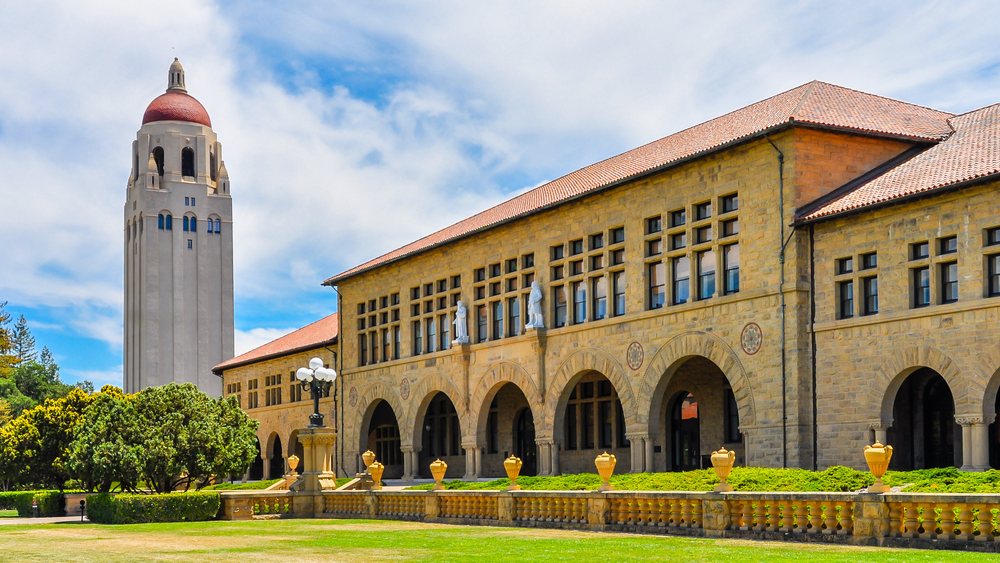
The image of the ‘Golden State’, Stanford or Leland Stanford Junior University, was founded by its namesake in 1891. Leland Stanford decided to go west of New York in the search of gold and opportunities.
There he founded, with his wife Jane, the university which is home to a flagship of innovation in the ‘Bay Area’ of California and is in effect one of the most highly reputed universities in the world (No.2 according to the QS University Rankings 2018). Its slogan is ‘The wind of Freedom blows’ (Die Luft der Freiheit weht).
Stanford’s campus is situated in a region known for the free circulation of ideas and for its successful technological enterprises like Facebook (at Menlo Park) LinkedIn (at Mountain View), and lots of others at Palo Alto. The University is situated 34 miles to the south (around 55km) of San Francisco and 22 miles north of San Jose (around 35km)
Stanford University in a few words
Life on Stanford’s campus
The promotion of 2021 is home to more than 7 000 students from more than 75 countries. The campus is familiarly known by the name of ‘The Farm’, derived from the era when horses rather than students roamed once was once the farm of the founders of the university, Leland and Jane Stanford.
At 87 meters, the Hoover Tower dominates all the other structures on campus. Named after the former president of the United States, the tower is home to a collection of works linked to the history of the 20th century offered by President Hoover. The tower offers to students and to visitors an impressive view of Stanford and its surroundings. The Hannah Honeycomb house was constructed by Frank Lloyd Wright from 1937. This octagonal house was originally the house for the scholars of Stanford. It is henceforth considered to be a historical site. Among the most visited places on the campus, we must mention the White Plaza, which is in many ways the center of student life on campus.
Academic life at Stanford
The professors at Stanford are considered to be among the best in the world. As of March 2018, 81 Nobel prize laureates, 27 Turing prize laureates and 7 fields medals have been affiliated with Stanford and as students, former students, professors or personnel members.
Additionally, Stanford University is particularly known for its entrepreneurial spirit and the capacity of its students to attract funds for startups.
The former students of Stanford have founded a great number of companies, producing together more than 2.7 million dollars of revenue annually and creating 5.4 thousand jobs in 2011, the equivalent of the world’s tenth largest economy (2011).
Stanford has shaped 30 living millionaires and 17 astronauts. It is also one of the principal producers of members of the United States congress. The university currently employs more than 2,000 professors.
Despite this incredible list of achievements, the students have plenty of time to define their own academic goals under the direction of professors, of personnel or former students.
Effectively, a number of students do not declare their ‘major’ until their second year (or ‘sophomore’) at Stanford.
Before choosing, the students meet with a ‘PMA’ or a ‘pre-major’ counselor. This person oversees a small group of first year students and helps them choose their classes and to navigate through university life until they declare a ‘major’ of studies.
In total, 57% of undergraduate students become graduates of a school of human sciences and sciences, which comprises programs as varied as afro-american studies, study of slavic language and literature, or physics and political sciences.
Among its other schools (or departments), Stanford is also home to a school of Earth Sciences, energy and environment and a School of Engineering. Additionally, is also home to 10 campuses across the world in cities like Le Cap, Hong Kong (from 2019), Istanbul, Kyoto, Oxford and Paris.
Every campus has a member of the faculty in residence and staff as well as students, which allows for the creation of a true ‘home from home’ for the students of Stanford.
How do I apply?
Apply for a Bachelor’s at Stanford
To apply to Stanford, you will need to use the Common App (or ‘common application’) centralized platform through which you can apply to the majority of American colleges and universities.
You must provide information on your family – including your parents’ professions-, provide your record of grades or high school grades, provide a mid-year report, submit 2 letters of recommendation, submit a ‘school report’, write a CV, send results of your official tests (ACT/SAT/SAT Subject tests- Note that the written parts of these examinations are obligatory), describe your extracurricular activities and, like for the majority of highly selective colleges, complete the development questions as a response to the supplementary dissertation questions specific to Stanford. You must submit all your documents before the appropriate deadline. If you are sure that Stanford is your first choice, you might want to make a request for ‘Restrictive Early Action.’ The anticipated documents must be submitted before November 1st. The university stipulates that you must complete the ACT/SAT by November.
The documents for a ‘regular decision’ application must be submitted before January 2nd. In this case, the students are allowed to choose to take the ACT/SAT at the end of February. Stanford does not require the SAT Subject Tests, but it is probably preferable to take the tests corresponding to your interests and your strong points.
The university does not require an English test, but they strongly recommend taking the TOEFL but does not recommend the IELTS.
Finally, the university will accept your highest scores of each section of the ACT/SAT separately, which they call ‘superscoring’.


The Application
Your application for the Bachelor’s to the university of Stanford must comprise the following elements:
- The ‘Coalition Application’ or ‘Common Application’ which comprises questions specific to Stanford :
- Lists and descriptions of all activities and accomplishments of the student (achievements, activities, employment and summer activities)
- Personal essay
- Stanford-specific questions
Your School Grades
- Official transcript of all your school reports
- Recommendation from a school counselor and school profile
- A complete
- ‘Mid Year-Report’
Standardized tests
- SAT or ACT score
- Score from a standardized English exam (IELTS, TOEFL, DET)
- 2 letters of recommendation from teachers
- These recommendations must come from teachers of academic disciplines
- For candidates for engineering, one of these must come from a teacher of mathematics or science.
Complementary documents for the application :
Optional interview with an alumnus/alumna
Supplementary materials

When do you have to start preparing for the University of Stanford
Taking into account the numerous specific requirements for American universities like taking exams; consistently participating in extra-curricular activities including clubs, music, sports, and side projects; and the numerous essays to write, we recommend that students begin start to think about their path to Stanford as soon as they begin high school. The application itself is typically completed during the fall semester of students’ last year in high school.
What is the profile of the students at the University of Stanford?
The admission process at Stanford is a ‘holistic’ process with takes into consideration numerous factors at considers each application on the whole and doesn’t just focus on academic results and tests.
What is the profile of the students at the University of Stanford?
Approximate school fees at undergraduate level (all USD):
Total school fees for Bachelor’s:
$228,832 for 4 years (57,208 per year)
Total budget estimated for a Bachelor’s:
$296,692 for 4 years

Total budget for one year: $74,173
- School fees and obligatory fees: $57,208
- Accommodation: $13,618
- Books and equipment: $1,246
- Other expenses: $2,101
School fees for a Master’s
Total costs of Master’s school fees: around $61,000 per year
Total cost estimated for a Master’s: $84,280 per year
Total budget for a year of a Master’s:
- School fees and obligatory fees: $61 006
- Accommodation: $17,298
- Book and equipment: $1,000
- Other expenses: $3,887
School fees for the LLM:
Total cost of school fees for the LLM: around $65,252
Total budget estimated for an LLM: $93,740
- School fees and obligatory fees: $ 70,660
- Accommodation: $21,505
- Books and equipment: $1,575
- Other expenses: $3,900
MBA School Fees:
Total cost of school fees for the MBA: $106,416
Total budget for the MBA: $168,307
Total predicted budget for a year of MBA: $110,914
Personal expenses: $6,066
School fees: $74,400
Obligatory fees: $3,693
Insurance and health costs: $4,480
Books and equipment: $900
Accommodation: $21,375
Are you ready to study at Stanford?
We’re here to help you.
Study at the University of St Andrews
The oldest university in Scotland

The University of St Andrews is the most highly renowned and the oldest university in Scotland. Along with >The University of Edinburgh, St Andrews is considered to be the best university in Scotland and one of the most prestigious in the United Kingdom, on the same level as Oxford or Cambridge.
Regularly classed as the third best university in the United Kingdom in all the national rankings, their students are the most satisfied in the U.K (Complete University Guide, 2018)! St Andrews, the university was established between 1410 and 1413- the first in Scotland- and comprising three colleges (University College, St Mary’s College and St Leonard’s College). Today, its student body of around 8000 at undergraduate level and 2000 graduates is composed of more than 135 nationalities and 45% are international students.
So, St Andrews is one of the most international universities in Scotland! The Complete University Guide classifies the Management, Divinity and the Middle Eastern and African Studies among its academic programs with the school of English, Philosophy, Anatomy and Physiology equally very well ranked by The Times and The Sunday Times.
Situated in the very picturesque city of St Andrews, the university was established between 1410 and 1413 and comprises three colleges (University College, St Mary’s College and St Leonard’s College).
Along with the University of Edinburgh, St Andrews is considered as the best university in Scotland and one of the most prestigious in the United Kingdom, on the same level as Oxford or Cambridge
The University of St Andrews in a few words
With more than 135 nationalities represented and 45% of students being international, Saint Andrews is one of the most international universities in Scotland.
The university is composed of 4 faculties. Their departments of Physics and Astronomy, of International Relations, of Information Technology, Geography, English, Management, Philosophy and Theology and African and Oriental Studies are among the most reputed at the university and are in the national top 3. Indeed, in the 2019 Complete University Guide, 24 out of the 25 subjects offered by St Andrews rank within the top 10 nationally making St Andrews one of only three multi-faculty universities (along with Cambridge and Oxford) in the UK to have over 95% of their subjects in the top 10.
Numerous illustrious mathematicians, scientists theologians and philosophers are graduates or affiliates of the University of St Andrews, from which there are six Nobel prizes.Recent alumni include the former First Minister of Scotland Alex Salmond; former Secretary of State for Defence Michael Fallon; HM British Ambassador to China Barbara Woodward; United States Ambassador to Hungary Colleen Bell; Olympic cycling gold medalist Chris Hoy; and royals Prince William, Duke of Cambridge, and Catherine, Duchess of Cambridge. Six Nobel Laureates are among St Andrews’ alumni and former staff: two in Chemistry and Physiology or Medicine, and one each in Peace and Literature.
Student life
Admission to the University of St Andrews is reserved to the very best students and requires you to obtain excellent academic results.
How do I apply?
- The application on UCASYou must first submit your application on the UCAS platform, the equivalent of Parcoursup in England. This file comprises a cover letter (Personal statement) as well as a letter of recommendation from one of your teachers.
- Taking a standardized English testIt will also be asked of you to demonstrate an excellent command of the English language and you must also generally pass a standardized English test like the IELTS.
- The Conditional Offer of AdmissionFinally, if your application is accepted in the selection process, you will then receive a ‘conditional’ offer of admission. This means that you will only definitely be accepted on the condition that you obtain the minimum results Baccalaureate (most often a ‘Bien’ reference in the French Baccalaureate) and at a standardized English exam (generally between 6.5 and 7.5 in the IELTS)

When do you have to start to prepare for the University of St Andrews?
The deadline for applying to the University of St Andrews is fixed at the January 15th of your final year.
Always bear in mind the preparation work necessary for admission to Saint Andrews, it is strongly recommended to start preparing your application from your penultimate year to maximize your chances of success.
What is the profile of the students at the University of St Andrews?
Because of the high selectivity of the university, we recommend to send your application to these universities only if you can demonstrate that you have excellent academic results and are sure of obtaining at least a ‘Bien’ grade at Baccalaureate.

Are you ready to study at Saint Andrews?
We’re here to help you.
Study at Princeton University
A legendary Ivy League school in New Jersey

Established in 1746 and therefore one of the oldest institutions of higher learning in the US, Princeton University is now one of eight elite American universities in the Ivy League. Additionally, it was ranked between 1st and 2nd best university worldwide for 16 of the 18 years between 2001 and 2018 by US News & World Report. QS World University Rankings places it at number 13 in 2018.
This private university has just under 5,400 undergraduate and about 2,700 postgraduate students. Its most well-recognized programs are consistently in the arts & humanities, natural sciences and social socials & management
Princeton University in a few words
The school is named for the famous alumni, the 28th president of the United States and former president of Princeton. Students enjoy its 600 acres set in suburban Princeton, New Jersey, which is about an hour by car from Philadelphia and about an hour and a half from New York City.
Concerning its academics, the highly reputed Woodrow Wilson School of Public and International Affairs delivers degrees from undergraduate to PhD. Among undergraduates the most popular majors include Public Policy Analysis, Computer Engineering, Econometrics and Quantitative Economics, History, and Operations Research. Nearly 75% of classes have fewer than 20 students and many are taught in small, interactive groups around tables in seminar style; general and beginner courses are taught as in a lecture setting.
Princeton Tigers, as its students and their mascot are known, are particularly faithful to their alma mater and many attend an annual reunion on campus held each May. Graduating from Princeton is indeed, like many American universities, equal to gaining lifetime access to a club, in this case, a very selective one!
Student Life
The beautiful campus of Princeton experiences all four seasons, including a colorful fall and a cold, snowy winter. Buildings are equipped with the latest technology and many residential colleges also provide comfortable common areas and dining halls.
Campus life
One of the things that differentiates campus life at Princeton is the presence of Eating Clubs. This group of 13 selective clubs are more than just off campus houses where students eat together; they are Princeton’s version of Greek Life. Moreover, they set the tone for the social scene on Thursdays and Saturdays. Located just off campus on “the street”, each member can bring two invitees to events on weekends. While they are likely to greatly influence your social life should you choose to join one, not every student is a member, nor need be.
How do I apply?
To apply to Princeton University, you will need to use the Common Application, a centralized platform through which you can apply to most American colleges and universities. You will need to fill in information about your family – including the occupation of your parents -, provide your transcript or high school grades, submit two teacher reference letters and a guidance counselor letter of reference, draft a résumé or CV, send official test scores (SAT, SAT Subject Test scores, ACT and English language test scores), describe your extracurricular activities and as with most highly selective colleges complete the essay questions on the Common App as well as answer additional essay questions specific to Princeton known as the Princeton Supplement. The application will be due on January 1st unless you are applying for Single Choice Early Action in which case you must submit all materials by November 1st.
The selection process for Princeton is divided into several steps that we describe to you below:
The application file
Your application to Princeton University must comprise the following elements :
- Your results from the SAT and from the Subject Test
- Your results from the TOEFL, IELTS Academic or the PTE Academic Test
- Your candidate file and the Princeton Supplement
- Your Princeton Financial Aid Application
- School Report, Guidance Counselor Letter and Transcript
- Teacher Evaluation Form 1
- Teacher Evaluation Form 2

When do you have to start preparing for Princeton?
Taking into account the numerous specific requirements for American universities like taking exams; consistently participating in extra-curricular activities including clubs, music, sports, and side projects; and the numerous essays to write, we recommend that students begin start to think about their path to Stanford as soon as they begin high school. The application itself is typically completed during the fall semester of students’ last year in high school.
Candidacy for ’Regular Decision’
What is the profile of students at Princeton?
With a rate of acceptance of 6,5% for Bachelor’s level, admission to Princeton is on an extremely competitive level at both Bachelor’s and Master’s level. According to our research, to have a good chance of being accepted,you must be at the top of your class and have a SAT score close to 1600 or an ACT score of around 35.

Are you ready to study at McGill?
We’re here to help you.
Study at the University of Nottingham
Academic excellence at a campus-based English university

The University of Nottingham is a public research university situated in the East Midlands in England, UK. Described by the Times as “the nearest thing Britain has to a truly global university”, Nottingham stands out because of its campuses in Malaysia and China as well as in the UK. Its status as a global university is reinforced by Nottingham’s rank in 2010 as 13th in the world for the number of former alumni listed among CEOs of the Fortune Global 500, sharing the position with Tohoku University in Japan and none other than Stanford University in California.
Renowned for its exceptional employability rating, Nottingham has been described as “one of the most employer friendly universities in the world” by Virgin’s Alternative Guide to British Universities. Likewise, in the Times Higher Education world ranking, Nottingham places amongst the top 15 most targeted universities in the world by leading employers. A place at the University clearly leaves you in good stead when it comes to career prospects – but what’s it actually like to study there?
Student Life
Student life at Nottingham is characterised by societies, sports clubs, volunteering projects, student-run groups and networks, and events such as pub quizzes, live music, club nights and comedy nights. Its established Students’ Union (SU) is to thank for the plethora of different activities on offer and is even responsible for the critically acclaimed and award-winning cinema and theatre group ‘The Nottingham New Theatre’. Likewise, Nottingham’s status as a ‘campus’ university means that students – in particular first year undergraduates – are within close proximity of one another. The campus allows for the presence of a centrally located social hub – in the form of a Students’ Union – where students can congregate and get to know one another. Nottingham’s principal campus – known as ‘University Parks Campus’ – is located within the City of Nottingham and just west of the city centre. The campus is very green and the vast array of social space means that students are often seen picnicking outside when the weather permits. Described as “one of the most attractive (campus’s) in the UK”, by the study-in-UK website, Nottingham’s beautiful and green campus really is home to thousands of happy students.
Academic matters
Academically, the University of Nottingham performs at an extremely high level. It forms part of the prestigious Russell Group and was ranked as the 16th best university in the whole of the UK, according to the Times University Guide 2019. In subjects such as Pharmacy and Pharmacology (6th), Education (22nd), Anatomy & Physiology (36th), Veterinary Science (29th), Nursing (42nd), Geography (46th) and English Language and Literature (49th), Nottingham ranks as one of the best universities in the world, according to QS World subject rankings 2018. Furthermore, Nottingham is ranked as high as 8th in the UK for the power and effectiveness of its research, with more than 97% of its research gaining international recognition, according to the 2014 Research Excellence Framework. Given this high standard of academic excellence, Nottingham has become one of the most competitive universities in the UK to gain entry to. Despite this, there are just over 9,000 international students currently enrolled at the university, which demonstrates the diversity amongst students Nottingham.
Nottingham is a great destination for international students. It is home to a university-run International Office that provides added support to students less familiar with the UK. This may range from a designated student on arrival to show you around the campus and help you settle in, to help with opening an English bank account or extending a visa.
English language lessons and social support are also on offer. Nottingham’s participation in English family home-stay programmes – where international students are given the chance to live and speak with local families nearby to the university – is a great way for foreign students to get up to speed with the culture and the language.
A fun fact about Nottingham is that it is said to be the home of Robin Hood – the legendary and heroic outlaw who forms part of English folklore and literature. With the Sherwood Forest National Nature Reserve not far from the city – where Robin Hood is said to have hidden – you never know what you may find in this special place. ‘Special’ is definitely a word that characterizes this university. Nottingham’s alumni have received prestigious awards such as 3 Nobel Prizes, a Fields Medal and ranked 2nd (together with Oxford) in the 2012 London Olympics for British medal winners. With established excellence in sport, academia and research, Nottingham really could be the university for you. Only a 20-minute drive away from East Midlands International airport, Nottingham is truly accessible for people from all areas of the world.
How Do I Apply?
For students wishing to apply to Nottingham, strong academic results and rigorous preparation are needed.
What are the different stages of the application?
There are several steps:
- Apply on UCAS
- Receive a conditional offer
- Meet requirements from your offer
- Confirm your acceptance
The details of these steps are covered below and on the University’s website.
How to begin an application:
Candidates apply via the British online platform UCAS, and upload a letter of motivation (Personal Statement), their predicted exam marks, and a letter of recommendation from one of their teachers. Students may only submit one Personal Statement for all the universities they apply for (maximum of 5 choices). The Personal Statement, no more than 4,000 characters, should explain why students want to study their chosen course, what aspects particularly interest them, what steps they have already taken to engage with the subject (reading, conferences, internships etc), and, if possible, what aspects they are looking forward to studying.
Conditional offer and acceptance:
If students succeed in all these stages, in January they will receive a ‘conditional offer’ of admission. This means that they will be accepted if they attain the required marks (most often a high grade in your end of high school studies, and in a standardized English exam: 7.5 in the IELTS for example).

What is the deadline for applying?
Deadlines:
The deadline for applications to the University of Nottingham is the 15th January of a students’ final year of secondary school or sixth-form college (Year 12).
Fees
University fees vary based on your choice of degree. To get an idea of how much you can expect to pay, follow the links below and select your preferred degree.
When taking into account the cost of any university, you should also consider the cost of living.
Nottingham provides an estimate for the cost of living, which can be found on this website: they provide a detailed list of costs you can expect to incur including housing and social costs.
You might predict an annual average budget of around £10,000 per year, including accommodation, transport, personal expenses etc.
When do you have to start preparing for the University of Nottingham?
It is recommended that students try to find aspects of their chosen course that genuinely interest them and to think deeply about why they wish to study this subject – after all, students are applying to study this subject full time for at least 3 years.
Is it possible to visit the campus?
Open days at Nottingham have now closed for this academic year. More information can be find here.
Are you ready to study at Nottingham?
We’re here to help you.
Study at the University of Cambridge
Academic excellence and tradition in the world’s 4th oldest university

The University of Cambridge is one of the most prestigious UK universities and is located in the charming town of Cambridge in England.
Second in the ranking of best universities in the world in 2018 (THE’s World University Ranking 2018), Cambridge has thousands of illustrious graduates. Cambridge alumni notably includes: Charles Dickens, Isaac Newton, Emma Thompson, Arianna Huffington, Alan Turing and Stephen Hawking. Moreover, 96 of their former students and professors have received the Nobel prize and 10 have received the Fields Medal.
Today, the University of Cambridge is home to more than 21 000 students who are part of 31 colleges and one hundred academic departments.
The University of Cambridge
The University of Cambridge shares numerous traditions with the University of Oxford, which explains why they are often grouped together with the term ‘Oxbridge’.
The University of Cambridge is home to more than 21 000 students who are part of 31 colleges and one hundred academic departments.
Second in the ranking of best universities in the world in 2018 (THE’s World University Ranking 2018), Cambridge has thousands of illustrious graduates. Cambridge alumni notably includes Charles Dickens, Isaac Newton, Emma Thompson, Arianna Huffington, Alan Turing and Stephen Hawking. Moreover, 96 of their former students and professors have received the Nobel prize and 10 have received the Fields Medal.
Alongside the University of Oxford, Cambridge is one of the most selective universities in England, even the world, with only 1 candidate in 5 admitted.
Academic matters
At the undergraduate level, 30 courses are on offer, from which students should pick just one. Some courses cover multiple subject areas, for instance:
- Natural Sciences allows students to choose modules in hard sciences, from Biology, Physics and Chemistry to Earth Sciences and Mathematics
- Human, Social and Political Sciences students can choose modules such as Politics and International Relations, Anthropology and Sociology
Most degrees on offer at Bachelor’s level are typically 3 or 4 years long. Each year at Cambridge is made up of three terms. Cambridge terms, like those at Oxford, are quite unique amongst UK universities, since each term is only 8 weeks long.
These intense study periods are packed full of activity, and allow a deep focus on academic matters through lectures, supervisions*, and private study. Science students typically have lab-sessions at least once a week, and students of essay subjects will normally have 1-2 essays to work on during each week of term.
*What are supervisions?
Oxford and Cambridge are unique amongst UK universities in offering regular one-to-one or small-group discussions with expert academics. These give students a chance to go deeper into the subject by asking questions, reflecting on topic content, and receiving extra reading recommendations personalised to your particular interests in the subject, or what you are hoping to explore further.
At Cambridge, you could find yourself in lectures or supervisions with the same academic that has professionally published a book or journal article on the topic you are studying!
Term-time is also the perfect time to interact with other students in between study sessions and through student societies. Read on for more about student life at Cambridge!
Living and studying in Cambridge
Cambridge students are housed within one of the 31 colleges, each with their own personality. For a good overview of the Cambridge colleges, their location in the city and student life there, see the university prospectus.
The Cambridge colleges are spread around Cambridge, a city with a bustling centre and plenty of green spaces, museums, and a stunning mixture of architecture. The colleges in themselves are havens for students in the city, offering a space to live, share meals with fellow students, relax, and of course study.
Study spaces are numerous, and include: departmental buildings and libraries, the University library, smaller College libraries, and other spaces such as shared or private study rooms, College JCRs (Junior Common Rooms), which also double as a place to socialise with other students of the College.
While Cambridge students work hard, they also like to ‘play hard’, and there are plenty of opportunities to make the most of the student experience at Cambridge. From traditional formal halls and May Balls, to the 959 (!) student societies on offer. Societies are a chance to get involved in something new, pursue an existing hobby.
Around Cambridge, you could also shake off your essay stress at a student bar, watch a show at the ADC theatre (whose stage once saw the likes of ex-students Rachel Weisz, Ian McKellen and Hugh Laurie) or see talks by big-name speakers at the cambridge union.
In terms of getting around the city, many people get around Cambridge (to lectures, for instance) on foot or by bike, although the city is also well served by buses. Travelling outside of Cambridge is also convenient: taking a train from Cambridge’s train station will allow you to get to London in under an hour, whether for a day-trip or for a weekend.
How do I apply?
Note: If you decide to apply to Cambridge for Undergraduate level in order to obtain a Bachelor of Arts (BA), you will not be able to apply to Oxford as well. You will therefore have to choose between either applying to Oxford or to Cambridge.
What are the different stages of the application?
There are several steps:
- Application
- Test
- Interview
- Conditional offer
- Acceptance
The details of these steps are covered below.
Beginning your application
Once you have decided on your ideal course of study, you will have to begin filling in the candidate file on the UCAS platform, which allows you to apply to up to 5 different courses/universities in the UK.
The UCAS application consists of a written Personal statement (of up to 4,000 characters) as well as a letter of recommendation from one of your teachers. After submitting your UCAS application, you will also be invited to fill out a Cambridge-specific Supplementary Application Questionnaire (SAQ), in which you will confirm certain details from your academic transcript.
You will also be asked to choose one of Cambridge’s colleges in your application, specifying choosing the one you wish to apply to. It is also possible to make an ‘open application’ (in which you do not indicate one college in particular, but will be assigned one automatically).
Interview and admissions tests
If your application is successful in the first stage (following submission of the UCAS application and Personal Statement), you will then be invited to an interview at the start of December in Cambridge. In this interview, the objective is to test your academic capacities and your motivation for your subject in front of a few members (‘fellows’) of the College you applied to. Given that Cambridge is highly selective, these interviews are very demanding and require a large amount of preparation.
If your application is successful in the first stage (following submission of the UCAS application and Personal Statement), you will then be invited to an interview at the start of December in Cambridge. In this interview, the objective is to test your academic capacities and your motivation for your subject in front of a few members (‘fellows’) of the College you applied to. Given that Cambridge is highly selective, these interviews are very demanding and require a large amount of preparation.
The conditional offer of admission
Finally, if you succeed in the interview stage, you will then receive a ‘conditional offer’ of admission. Offers should be received by 15th January.
Our Oxbridge Admissions Pack can help you through the entire Cambridge or Oxford admissions process.
When do you have to start preparing for the University of Cambridge?
The deadline for applying to the University of Cambridge is fixed at October 15th of your final year.
In all cases, take into account the huge scale of preparation required for admission to Cambridge, it is strongly recommended to start preparing yourself from the start of your penultimate year in order to maximize your chances of success.
A good way to prepare for studying in Cambridge is to have a good look at the information for your course so as to know what to expect. Once you are confident in your choice of subject and your determination to study at Cambridge, you should begin researching your course further by reading around your subject.
It would also be a good idea to go to an open day. Open days run throughout the year, but most occur in the months leading up to October. For specific dates, you should look out for subject-specific open days, college-specific open days, and university-wide open days.
In 2019, Cambridge will be holding uni-wide open days on 7 & 8 July 2022. For these open days, booking is necessary: Sign up to the Student Newsletter to be notified when bookings open and for other opportunities, advice and resources.
What is the profile of the students at the University of Cambridge ?
Admission to the University of Cambridge is reserved for the best students and requires both excellent school results and lots of rigorous preparation.
Given the extreme selectivity, we recommend that you only apply to this University if you can show excellent academic results and can be sure of obtaining the highest grades in your final year of pre-university studies (i.e. a ‘Très Bien’ grade in the French Bac). The University of Cambridge is also particularly reputed for their science programs and expectation will be even higher for these.
Moreover, given the selection process contains interviews, you must also master the English language.
If you are confident that you fit the profile of a Cambridge student, the next step is to reflect on whether the workload and supervision system is right for you.
Finally, you should do all that you can to start preparing for studies at Cambridge, in order to create a stand-out application and so that you can adapt well to new the living and studying conditions on arrival.

Financing your studies
Fees:
Following UK Government’s amendment of the regulations relating to fee status due to Brexit, EU, EEA and Swiss students will now be classified as international/overseas students.
Tuition fees for international students vary depending on the course studied. Most international students also have to pay College fees in addition to tuition fees. See this page for details.
Are you ready to study at Cambridge?
We’re here to help you.
Study at the University of Bath
A university with a global outlook in an exceptional setting

The University of Bath is nestled in the region of Somerset, England, one hour by train from London on a hilltop overlooking the town of Bath.
Bath is one of the top universities in England and in 2018 it took the 6th spot in national rankings in The Guardian and the 160th place in the QS World University Ranking.
In 2014, it also achieved the title of ‘Best Campus University in England’ in the Times, a list that it continues to appear on. So what makes this place so special?
The city of Bath
With around 90,000 year-round residents, Bath just may be the most charming city in England. The Telegraph agrees saying that the city, which is a World Heritage Site, “pretty much ticks all the boxes”.
Tourists come from far away to visit the famed Roman Baths as well as more modern spas – the city’s full name is Bath Spa after all. The Bath Abbey and the Royal Crescent and Circus – both beautiful Georgian architectural feats inspired by the city’s Roman heritage – the Jane Austen Centre, beautiful green parks… these are just a few of the most popular landmarks!
Students will find that the city, located a short bus ride down the hill from the University of Bath’s campus, also offers plenty of eateries, bars, nature activities, cultural events and stunning scenery.
The campus
The main campus of the university, reminiscent of many American college campuses, is situated in the periphery of Bath, and was constructed in 1964 in the modernist style of the era. The University’s proximity to such a charming city and its academic excellence make it a great alternative to London’s universities (an hour away by train) if you’re hoping for a campus university experience. Regarding accommodation, first-year students are guaranteed on-campus housing in the first year while afterwards they tend to move off campus to live with friends.
Academic matters
Over 17,000 university students study in one of Bath’s four faculties (Engineering and Design, Humanities and Social Sciences, Management, and Science). Since it opened in 1966, Bath has been particularly reputed for engineering (electronic, electric and mechanical in particular), physical sciences, mathematics and technology. Today, Bath is also well known for management, humanities, architecture and the social sciences – especially psychology. See the full list of course offerings here.
Bath aims to help students gain professional experience and in many of its courses offers the chance to take a year to work in industry in order to acquire professional experience before graduating.
Moreover, Bath’s campus is in a state of constant improvement and has benefited from an investment of £450 million over the past 10 years. A five-storey library has room for individual study, group work, and engineering and design space and more. Plus, it’s open 24 hours a day, even in exam term, which proves useful for night owls and early birds alike! Among other recent developments are a brand new Psychology building that houses one of the University’s most highly-ranked programs. Equally acclaimed is the School of Management whose new building will be opening in 2021. In addition, The Edge, a building for both management and arts, offers concerts as well as events, and the Sports Training Village, which includes a range of sports facilities including indoor tennis courts and a swimming pool, weight rooms, and an indoor as well as an outdoor track. With such great facilities, it may not come as a surprise that Bath also enjoys a reputation as one of the leading UK universities for athletics, offering all kinds of sport activities from American football to Canoe Club, Dodgeball, Jiu Jitsu, Latin and Ballroom dancing and Windsurfing!
Outside of competitive programs, sports, arts activities and ample green spaces on campus and around the city, students at the university can also join a range of other student associations to make the most of their campus experience and contribute to continuing to make Bath one of the UK’s top campus universities!
How do I apply?
To apply to the University of Bath, as with other UK universities, you will need to submit a candidate file on UCAS, including a Personal Statement, teacher’s letter of recommendation, proof of English proficiency where necessary (by sitting a standardised test), predicted results for your current studies (or grades already achieved) as well as your contact information and details on any past work experience you have completed.
See Your Dream School’s tips for applying for more information.
Also refer to the pages Applying for an undergraduate course or Applying for an graduate course on the University of Bath’s website.

Are there any specific requirements?
Each subject will have its own specific entry requirements. This information will be detailed on the course page for your specific course.
When do you have to start preparing for the University of Bath?
The deadline for applying to Bath for the Bachelor’s is fixed at January 15th of your final year.
In all cases, take into account the preparation work necessary for admission to Bath, we strongly advise you to start preparing your application from your penultimate year in order to maximize your chances of being accepted.
What is the profile of the students at the University of Bath?
Given the high selectivity of the university, we recommend that you only apply to this university if you can show excellent academic results and that you are sure of obtaining high grades in your end-of-year exams in the International Baccalaureate, A Levels or equivalent.
Moreover, you must also show an excellent command of the English language.
Certain programs at Bath like engineering and management receive a huge number of applications annually and generally require A grades at A Level, or in equivalent qualifications.

Are you ready to study at HEC Montréal?
We’re here to help you.
