In this article
- GRE vs GMAT: the differences that really matter
- Which test for which program? (MBA, MiM, Finance, MSc)
- Self-assessment: GRE or GMAT for your profile
- School policies, score equivalences and waivers
- Quick action plan to decide and prepare
- Common mistakes when deciding between the GRE and GMAT
Struggling to choose between the GRE and the GMAT? Good news: most business schools and selective master’s programs accept both tests. So the real question is: GRE or GMAT, which one gives you the best chance of getting into an MBA, a Master in Management, a Master’s in Finance/Analytics or a non-business MSc, given your strengths and the admissions policies of your target schools? Follow this guide to make a quick, well-informed decision.
GRE vs GMAT: the differences that really matter
Overview
| Criterion | GMAT (Focus) | GRE (General) |
|---|---|---|
| Positioning | The benchmark for MBA/MiM; logic, critical reasoning, data | Accepted for MBA programs and widely used for MSc/PhD programs (sciences, economics, social sciences) |
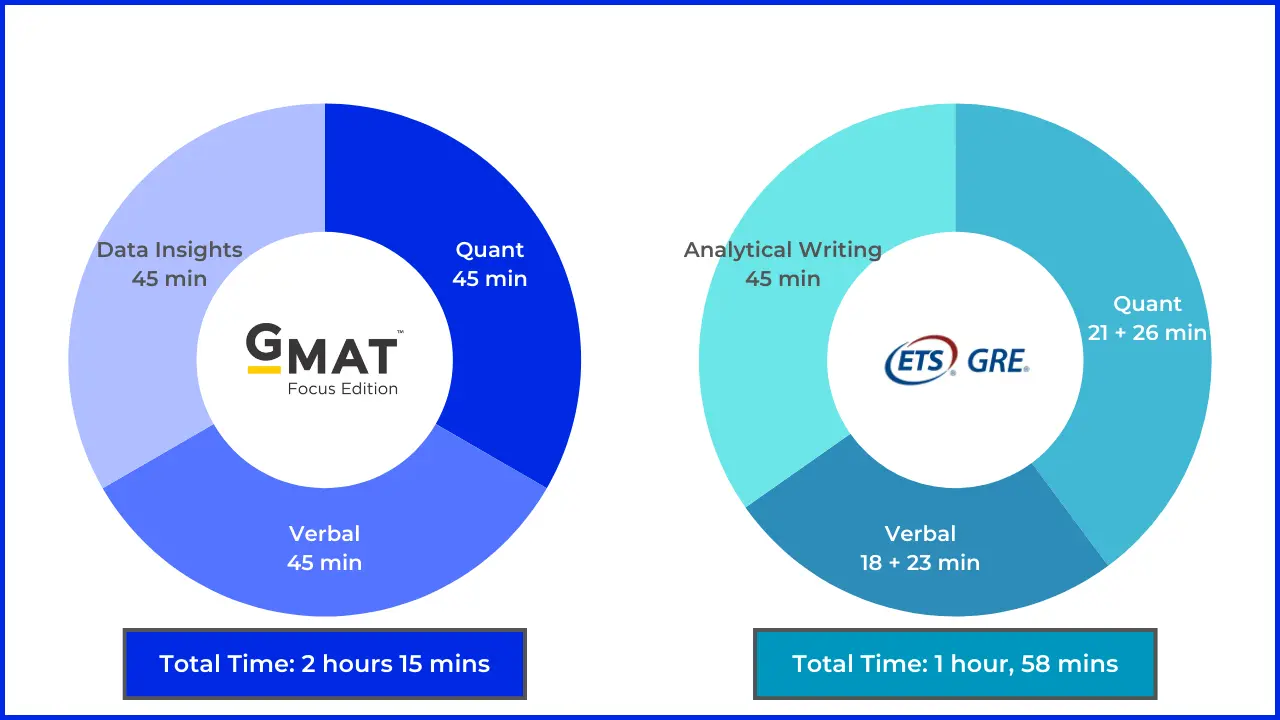
| Key sections | Quant, Verbal, Data Insights (data analysis) | Quant, Verbal, Writing (one analytical essay) |
| Verbal | Strong emphasis on Critical Reasoning and understanding arguments | Strong emphasis on vocabulary (Text Completion / Sentence Equivalence) |
| Quant | Business-style problems, mental math and choosing the right method | Similar content, sometimes slightly closer to school math |
| Main advantage | A clear business signal for MBA/Finance | Versatile (MBA + MSc) and a good fit if you enjoy vocabulary-heavy verbal questions |
Quick takeaway: for an MBA or Master’s in Finance, the GMAT is often still the strongest signal. For non-business MSc programs, or if your strengths are vocabulary and dense reading, the GRE may give you an edge.
Which test for which program? (MBA, MiM, Finance, MSc)
Full-time, part-time and executive MBA
- GMAT recommended if your application needs to send a strong quantitative/reasoning signal.
- GRE accepted by most MBA programs: a good choice if you are very comfortable with vocabulary and reading.
- Check the school’s published GMAT medians and GRE ranges to gauge how competitive you are.
Master in Management (MiM), Master’s in Finance/Analytics
- Many schools prefer the GMAT (quant + data signal). That said, the GRE is still accepted.
- If you are aiming for a selective Master’s in Finance, go with the GMAT unless the program says otherwise.
MSc (economics, sciences, social sciences, data, public policy)
- Outside business schools, the GRE is often the long-standing standard.
- The GMAT may work for MSc programs with a strong business/analytics focus. Check the program’s admissions page.
Self-assessment: GRE or GMAT for your profile
Choose the GMAT if this sounds like you
- You enjoy reasoning through arguments (logic, cause and effect, plans of action) and reading business/economics passages.
- You are comfortable analyzing tables and graphs and working with unit conversions and percentages.
- You are mainly targeting MBA/MiM/Finance programs (market signal).
Choose the GRE if this sounds like you
- Very strong English vocabulary and a liking for dense reading.
- You are also considering non-business MSc/PhD programs (a more versatile score).
- You want a Writing section to showcase your analytical and writing skills.
Still undecided? Run an A/B test
- Take a short GMAT diagnostic and a short GRE diagnostic under real test conditions in the same week.
- Compare your percentiles (not just raw scores) and the estimated additional effort needed to reach your schools’ medians.
- Choose the test where your rate of improvement looks most promising over 8-12 weeks.
School policies, score equivalences and waivers
Check each program’s policy
- Many schools publish GMAT medians; some also publish GRE ranges.
- Some programs offer waivers (e.g. for substantial quantitative experience or specific degrees). Read the “Admissions Requirements” page.
Approximate GMAT ↔ GRE equivalences (for reference)
There is no exact equivalence, but as a rough guide (using percentiles), a competitive GMAT for a top MBA often falls within the high percentiles, which correspond to a GRE Verbal + Quant score that is likewise well above average. Use the official percentiles for both tests to compare your results objectively.
Academic English: a separate requirement
The GRE/GMAT does not always replace proof of English proficiency. Compare the English tests schools expect here: IELTS vs TOEFL: which test should you choose?.
Quick action plan to decide and prepare
Week 0: decide
- List 6-8 target programs and their testing policy.
- Run the A/B test (short diagnostics) and choose between the GRE and GMAT within 7 days.
Weeks 1-4: fundamentals + strategy
- Work on 2 major weaknesses (e.g. CR or Text Completion; statistics or probability).
- Keep an error log and make flashcards (vocabulary for the GRE; principles and logic for the GMAT).
Weeks 5-8: ramping up
- Timed sets 2-3 times a week + practice tests in weeks 4 and 8.
- Practice time management (checkpoints) and smart guessing.
Weeks 9-12: full simulations and final polish
- 1 full mock test per week, in-depth review, and work on recurring mistakes.
- Polish the rest of your application (essays, CV, recommendations). See examples here: Personal Statement examples.
Common mistakes when deciding between the GRE and GMAT
Focusing on “the more prestigious test”
No serious school penalizes a good GRE score compared with a good GMAT score (or vice versa). Choose based on your strengths and the program’s approach.
Ignoring field-specific policies
A Master’s in Finance may favor the GMAT; an MSc in economics/data may be more open to the GRE.
Putting off the decision
Two weeks of hesitation means two weeks of lost study time. Run the A/B test and commit.
FAQ: GRE or GMAT
Is the GMAT “required” for MBA programs?
No. Most MBA programs accept the GRE. But if your target school reports a high median GMAT, the GMAT may carry more weight with its admissions committee, especially for highly quantitative programs.
Can I take both tests?
Technically yes, but preparing for both is rarely worthwhile. Focus your effort on the test where your percentiles rise fastest.
Does a strong score make up for everything?
No: schools also assess your essays, experience, recommendations and interviews. Prepare your whole application.
Need a quick opinion to decide between the GRE and the GMAT? We assess your strengths and target schools, then build an 8–12 week plan with measurable goals and practice tests at the right pace.
 Author
With a Bachelor's (LLB) from UCL and Assas, and the Grande Ecole program at HEC Paris, Adam co-founded Your Dream School in 2018. Since then the company has coached more than 1,000 students through university admissions and interview preparation for top global institutions.

Need personalized guidance? Talk to our experts.
Talk to an Expert →

