In this article
- Understanding the UCAS reference
- Who to choose (and who to avoid) as your referee
- How to brief your teacher (referee)
- What should a good UCAS reference include?
- Deadlines, predicted grades and coordination
- Special cases
Further reading: UCAS: the complete guide to applying to UK universities
Your UCAS reference (the academic reference submitted with your application) carries a lot of weight: it lends credibility to your predicted grades, your academic potential and your fit with the courses you are applying for. Here is how to choose the best referee, brief them effectively and avoid the pitfalls that weaken a UCAS recommendation letter.
Understanding the UCAS reference
What is the UCAS reference for?
- To give an independent assessment of your abilities (rigour, method, progress).
- To put your results in the context of your class and school.
- To confirm that your plans make sense for the courses you have chosen on UCAS.
Who usually writes it?
- A teacher of a key subject (maths/physics for engineering, literature for humanities, etc.).
- A tutor, Head of Year or pastoral lead who has known you over a long period and knows how you have progressed.
- The guidance counsellor (if your school handles UCAS references centrally).
Important: the UCAS reference is confidential and is submitted by the school or referee, not by the applicant.
Who to choose (and who to avoid) as your referee
Good options
- A teacher of a core subject for your course (e.g. maths → economics/data/engineering).
- A teacher who can point to concrete evidence (marked papers, competitions, projects).
- A referee who writes well, meets deadlines and is willing to tailor the content to your chosen courses.
Who to avoid
- Family, friends, or employers with no academic connection (lack of objectivity).
- A teacher who is rarely available or who does not know you well enough.
- A “generic” reference that is the same for every course.
Quick reference table
| Referee profile | When it is relevant | Expected strengths |
|---|---|---|
| Teacher of a key subject | Selective courses in a matching subject (STEM, law, economics…) | Subject knowledge, method, results |
| Tutor/Head of Year | Overall picture, progress over 2–3 years | Consistency, maturity, time management |
| Guidance counsellor | UCAS coordination & school context | Comparison with the cohort, professionalism |
How to brief your teacher (referee)
A simple, effective briefing pack
- A one-page CV (results, projects, competitions, responsibilities).
- The list of UCAS courses you are targeting, plus 2–3 arguments per course (how each one links to your profile).
- Evidence bullet points (see below): your top 3 marked papers, a science fair project, olympiads, code/portfolio.
- Your school’s internal UCAS deadlines (plus a reminder 10–14 days beforehand).
Ready-to-use bullet points for your referee
- Rigour & method: “Homework always complete, solutions explained step by step, average up by 2 points this year.”
- Analysis: “AI project: F1 score improved by 7% through iteration, code documented on GitHub.”
- Communication: “Poster presentation, 2nd prize in a regional competition.”
- Teamwork: “Scrum master for a team of 4, delivered on time.”
Sample email to brief your teacher
Subject: UCAS reference: supporting information & deadline
Dear Ms/Mr [Name],
Thank you for agreeing to be my UCAS referee. Please find attached my CV (1 page), the UCAS courses I am applying for and some supporting evidence. The internal deadline is [date]. I am happy to provide anything else you may need (marked papers, my GitHub project, further details). Thank you very much!
What should a good UCAS reference include?
Recommended structure
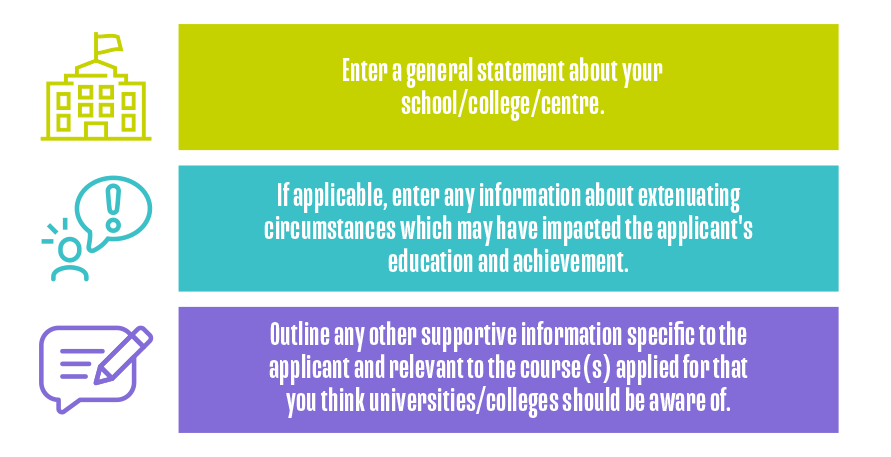
- Context (subject taught, how long the referee has known you, your position within the class or cohort).
- Academic abilities: reasoning, method, writing, lab work, rigour.
- Evidence: quantified results, competitions, projects, progress.
- Fit with the UCAS courses listed (academic motivation, maturity).
- A clear conclusion (an unreserved recommendation, courteous tone).
Tone and useful keywords
- “Evidence-based”, “analytical”, “independent learner”, “research-minded”.
- Avoid empty superlatives (“excellent”, “brilliant”) that are not backed by evidence.
Deadlines, predicted grades and coordination
Plan ahead
- Set an internal deadline with your school 2–3 weeks before the UCAS deadline.
- Follow up politely 14 days and then 7 days before the deadline, with a summary of your application.
Predicted grades
- Your UCAS reference must be consistent with the predicted grades submitted by your school.
- If you have made strong progress recently, provide evidence (tests, homework, mock exams).
Special cases
Changing schools / applying independently
- Ask for a composite reference: a contact at your previous school plus your current tutor.
- If you are applying independently, find an academic referee (teacher, tutor, foundation programme director) who genuinely knows you.
Changing direction or taking a “gap year”
- Ask your referee to highlight your transferable skills (method, organisation, communication) and the coherence of your new plans.
Common mistakes to avoid
The 6 classic pitfalls
- A reference with no quantified evidence or examples.
- A text that is too generic or irrelevant to the courses.
- Leaving out the context (class size, academic standards).
- Inconsistency with your Personal Statement or predicted grades.
- Late submission (which costs you credibility).
- Choosing a referee who is unavailable or does not know you well.
Useful Your Dream School resources
To align your reference, personal statement and timeline
- Writing tips: how to write your UCAS Personal Statement.
- Planning: UCAS timeline and key dates.
FAQ: UCAS reference
Can I read my UCAS reference?
The UCAS reference is designed as a confidential assessment submitted by your school or referee. Focus above all on a solid brief and clear evidence.
How many UCAS references do I need?
A single UCAS reference covers all your UCAS applications (universities receive it through the platform).
Can an employer write the reference?
Only if they are an academic supervisor (foundation year, laboratory) or if your school appoints them. Otherwise, choose a teacher.
Need an expert view on your UCAS strategy (choice of referee, brief, consistency with your Personal Statement)? We can review your application and put together an evidence plan for a high-impact UCAS reference.
📚 Further reading
- Studying in the UK in 2026: the complete guide
- UCAS Personal Statement 2026: the complete guide
- UCAS 2026 timeline: key dates
- Top 10 UK universities in 2026
Need support? Discover our admissions coaching: your first consultation is free.
Further reading
- UCAS Personal Statement 2026: a complete guide for international applicants
- Studying in the UK in 2026: UCAS, deadlines, budget and visa
- UCAS Tariff Points: how to convert your baccalauréat/IB grades into UCAS points
 Author
With a Bachelor's (LLB) from UCL and Assas, and the Grande Ecole program at HEC Paris, Adam co-founded Your Dream School in 2018. Since then the company has coached more than 1,000 students through university admissions and interview preparation for top global institutions.

Need personalized guidance? Talk to our experts.
Talk to an Expert →

